

Stem Cell Sources for Huntington's Disease: Comparison
If you want the short answer: no stem cell source is approved for Huntington’s disease, and each one fits a different job. In HD, the main question is simple: can the cells replace lost striatal neurons, protect the ones left, or do both? Right now, ESCs and NSCs are the closest to direct brain repair studies, iPSCs are used mostly for lab modeling and gene correction work, and MSCs are aimed more at neuron support than replacement.
Here’s the fast takeaway:
- ESCs can make striatal neuron types, but they come with tumor risk and usually need immunosuppression
- iPSCs can be made from a patient’s own cells, but in HD they still carry the HTT mutation unless corrected first
- MSCs have the lowest tumor risk of the four, but they are poor at rebuilding lost striatal circuits
- NSCs sit between replacement and support, and in 2026 they are in an early HD human trial
- The main human study in this space is REGEN4HD, a Phase 1b/2a trial enrolling 21 early-stage patients ages 18–65
- Current goals are still safety and tolerability, not proof of cure or disease change
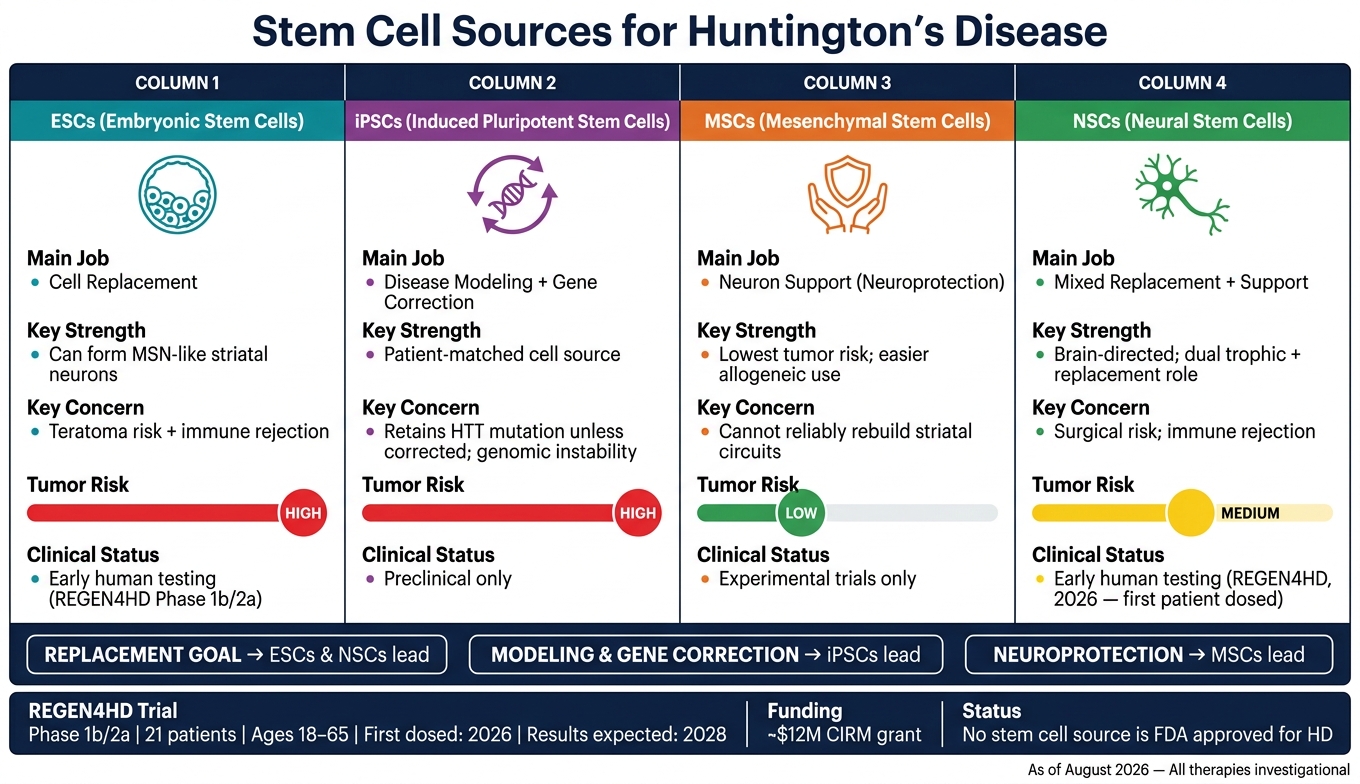
Quick Comparison
| Source | Main job in HD | Main strength | Main concern | Clinical status as of August 4, 2026 |
|---|---|---|---|---|
| ESCs | Cell replacement | Can form MSN-like cells | Teratoma risk, HLA matching and immune mismatch | Early human testing through an ESC-derived NSC product |
| iPSCs | Disease modeling; later replacement after correction | Patient-matched cell source | Mutation retention, tumor risk, genomic changes | Preclinical for therapy |
| MSCs | Neuron support | Lower tumor risk, easier donor use | Weak direct neuron replacement | Experimental trials only |
| NSCs | Mixed replacement + support | More brain-directed than MSCs | Surgical risk, immune rejection, graft control | Early human testing |
Put another way: there is no single “best” stem cell source for HD. I’d frame it like this: if the goal is replacement, ESCs and NSCs lead the conversation; if the goal is modeling and gene correction, iPSCs matter most; if the goal is supporting stressed neurons, MSCs are the better fit.
That’s the core comparison the full article walks through.
1. Embryonic Stem Cells (ESCs)
Therapeutic Role in HD
ESCs are pluripotent cells taken from the inner cell mass of a 5–7-day human blastocyst. In Huntington’s disease (HD), that matters because ESCs can be guided to form medium spiny neurons (MSNs), the striatal cells hit hardest by the disease.
The goal is simple in theory, even if the lab work is anything but: make new neural cells that can replace lost cells and help the striatal neurons that are still hanging on. But that only works if researchers can control differentiation with care and remove the wrong cell types before transplant.
Lab Preparation
Before anything moves toward treatment use, researchers check ESCs for genetic stability, pluripotency, and sterility. From there, they steer the cells into striatal-like neural progenitors with dual-SMAD inhibition, along with SHH and WNT modulation, to make striatal-like neurons.
One published 80-day protocol used SB431542, Noggin, DKK1, BDNF, and the ROCK inhibitor Y-27632. It generated MAP2⁺/GABA⁺ MSNs from pluripotent stem cell lines and improved behavioral outcomes in lesion-based rat models.
After differentiation, the cells go through more filtering and testing. They are purified, expanded under GMP conditions, and checked for:
- Sterility
- Identity
- Purity
- Viability
- Potency
This step is a big deal. Even a small leftover group of undifferentiated cells can increase tumor risk.
Safety Concerns
The main safety issue with ESCs is tumor formation. Undifferentiated cells divide fast, and animal studies show that even small numbers of these leftover cells can lead to teratoma growth. That is why careful predifferentiation and purification are so important.
There’s another issue too. ESC-derived products are usually allogeneic, which means the cells come from a donor source rather than the patient. So patients may need immunosuppression. On top of that, some ESC lines show genetic and epigenetic instability, which adds another layer of risk and makes strict quality control and long-term follow-up a must.
Clinical Readiness
As of mid-2026, ESC-based therapy for HD is still experimental, but it has moved into early human testing. UCI Health launched the REGEN4HD trial, a phase 1b/2a study testing hNSC-01, a neural stem cell product derived from human ESCs.
The trial plans to enroll 21 early-stage patients ages 18–65. The cells are delivered straight into the striatum through stereotactic neurosurgery, with intraoperative MRI guiding placement.
That makes this study notable: it is the first ESC-derived neural stem cell product tested in HD patients. ESCs still serve as the potency benchmark for cell replacement in HD. At the same time, their allogeneic source and tumor risk make clinical use more complicated. By contrast, iPSCs try to offer similar neural potential with patient-specific sourcing.
2. Induced Pluripotent Stem Cells (iPSCs)
Therapeutic Role in HD
iPSCs are adult skin or blood cells that scientists reprogram into a pluripotent state. In Huntington’s disease (HD), they play two main roles: disease modeling and, in theory, patient-specific cell replacement. That puts iPSCs in a strong position for patient-matched modeling, but not as a routine transplant source at this stage.
For modeling, patient-derived iPSCs can be turned into medium spiny neurons (MSNs). Researchers then use those cells to study mutant HTT biology, test how the disease works, and screen drugs in the lab.
For replacement, autologous iPSCs can be gene-corrected and transplanted into the striatum. In rodent models, iPSC-derived neural progenitors have survived, differentiated, and partly improved motor function.
Lab Preparation
That promise depends on careful reprogramming and strict quality control. The first HD iPSC lines, generated in 2008 from patient fibroblasts, marked a turning point for HD modeling.
Today, the workflow usually looks like this:
- Collect patient cells and reprogram them into iPSCs
- Confirm pluripotency and genomic stability
- Differentiate the cells into neural progenitors or MSNs using SHH and BDNF
- Measure the HTT CAG repeat length to make sure the line matches the intended disease genotype
- Check neuronal markers and functional neuronal activity before any transplant work
Non-integrating reprogramming methods, such as Sendai virus or episomal plasmids, are now preferred over older integrating vectors because they lower mutational risk.
Safety Concerns
The biggest concern is tumor formation from leftover undifferentiated cells. c-MYC, chromosomal changes, and epigenetic drift add more risk. Put simply, if even a small group of cells doesn’t behave as planned, the whole therapy becomes much harder to justify. That’s a big reason direct clinical use of iPSCs in HD patients is still not feasible right now.
Clinical Readiness
iPSC therapy for HD is still preclinical. Even so, patient-derived lines are widely used for modeling, gene editing, and drug screening.
One of the most important steps forward came from combining CRISPR with piggyBac transposon systems. This approach has enabled scarless correction of expanded CAG repeats in HD iPSCs, along with reversal of HD-associated phenotypes in culture. So while iPSCs don’t yet offer a clinic-ready path, they do serve as a strong proof-of-concept platform.
Unlike iPSCs, the next source matters less for replacement and more for support.
3. Mesenchymal Stem Cells (MSCs)
Therapeutic Role in HD
If ESCs and iPSCs are built to replace cells that are gone, MSCs are aimed at protecting the cells that are still there.
That difference matters. MSCs mostly help surviving neurons through trophic support and anti-inflammatory effects, not by turning into new brain cells and taking over the job. In practice, their main effect seems to come from paracrine signaling rather than long-term engraftment.
A 2023 meta-analysis reported gains in brain morphology, motor coordination, and muscle strength. But it did not find improvement in cognition.
Researchers are also testing MSCs as delivery vehicles for BDNF or RNAi. The goal is to support striatal neurons and reduce mutant huntingtin.
So, MSCs are best viewed as a support approach, not a replacement approach.
Lab Preparation
MSCs can come from several tissue sources. Adult sources include bone marrow, adipose tissue, and dental pulp. Newborn sources include umbilical cord tissue and placental tissue.
Cord tissue, especially Wharton's jelly, is a rich source of MSCs. These neonatal MSCs often show higher proliferative capacity and stronger immunomodulatory activity than MSCs from adult tissues.
After collection, the tissue is processed with enzymatic digestion. MSCs are then isolated through density gradient centrifugation and plastic adherence. From there, the cells are expanded under Good Manufacturing Practice (GMP) conditions.
Labs check markers such as:
- CD73
- CD90
- CD105
They also test for sterility, karyotype stability, and differentiation capacity. In more advanced HD programs, MSCs may be genetically modified before transplantation to overexpress BDNF or carry RNAi constructs.
Source, expansion method, and genetic modification all shape safety.
Safety Concerns
MSCs carry a lower tumor risk than ESCs or iPSCs. Their immunomodulatory profile also makes allogeneic use more feasible.
That said, long-term culture can still introduce genomic instability, so karyotype monitoring stays important.
The delivery route adds another layer of risk. Intravenous infusion can bring concerns about microvascular obstruction or infusion reactions. Intrastriatal injection comes with neurosurgical risks such as bleeding or infection.
Early-phase trials have generally reported few serious adverse events when protocols are followed. Still, long-term HD-specific safety data remain limited.
Clinical Readiness
MSC therapy for HD is still experimental. Trials are underway in the U.S. and other countries, but none is FDA approved.
Newborn tissue banking preserves cord tissue and placental tissue, both rich sources of MSCs. Americord Registry offers cord tissue and placental tissue preservation in the U.S.
4. Neural Stem Cells (NSCs)
Therapeutic Role in HD
NSCs sit in the middle between cell replacement and cell support.
On one side, they may turn into MSN-like cells. On the other, they can release neurotrophic factors such as BDNF. They may also produce interneuron-like cells and glial cells. In preclinical HD models, transplanted NSCs have also been linked to lower neuroinflammation and better survival of the tissue that remains.
Two recent mouse studies help show why people are paying close attention to this cell source.
- In a 2023 study in zQ175 HD mice, transplanted human NSCs survived for 8 months, improved motor behavior, increased BDNF levels, and reduced mutant huntingtin accumulation.
- A 2024 study reported that implanted human NSCs differentiated into mature medium spiny neurons in a Q175 HD mouse model and improved functional outcomes.
That puts NSCs in a clear middle-ground position for HD. They lean more toward replacement than MSCs, but they are more lineage-restricted than ESCs or iPSCs.
Lab Preparation
For HD, NSCs are usually derived from ESCs or iPSCs through stepwise striatal differentiation, with SHH and Wnt modulation.
One example is the Hedgehog agonist purmorphamine, which has been used to increase the yield of DARPP-32-positive MSN-like cells. Researchers then check striatal identity using markers such as DLX2, MASH1, and MEIS2.
Before any clinical use, batches go through a set of release tests. These checks look at:
- Sterility
- Mycoplasma
- Karyotype stability
- Genomic integrity
- Residual pluripotency markers
Final GMP batches are cryopreserved and delivered stereotactically to the striatum.
Safety Concerns
The main risks are familiar but serious: residual pluripotent cells, surgical injury, and immune rejection.
Teams try to lower those risks with purification steps, MRI guidance, and immunosuppression. Current trials also build these concerns into the study design through dose escalation, MRI-guided surgical targeting, immunosuppressive regimens, and long-term neurological follow-up.
Clinical Readiness
In 2026, REGEN4HD dosed its first patient.
The trial is enrolling 21 adults ages 18–65 with early-stage, genetically confirmed HD. That group includes 12 people in a Phase 1b dose-escalation cohort and 9 in a Phase 2a expansion cohort. The program is funded in part by a nearly $12 million grant from the California Institute for Regenerative Medicine (CIRM).
Right now, the main goal is safety and tolerability, not proven efficacy. Data are expected in 2028, with completion projected for 2031.
NSC therapy for HD is not FDA approved and remains strictly experimental. Those trade-offs lead directly into the source-by-source pros and cons below.
Pros and Cons of Each Stem Cell Source
These four stem cell sources differ most in one key way: do they replace lost neurons, or do they help the ones that are still there? That split shapes almost every trade-off.
| Stem Cell Source | Main Advantages | Main Disadvantages | Best-Fit Goal |
|---|---|---|---|
| ESCs | Pluripotent and expandable; can generate striatal neurons | Ethical concerns because they come from embryos; high immune rejection risk; teratoma risk if undifferentiated cells remain | In vitro modeling and drug screening now; long-term cell replacement if safety and immune issues are solved |
| iPSCs | No embryo use; patient-specific lines possible; best source for patient-specific HD modeling; autologous grafts can reduce immune rejection | Retain the HD mutation unless gene-corrected; reprogramming can introduce genomic instability; tumor risk remains | Patient-specific modeling now; autologous cell replacement after gene correction |
| MSCs | Easy to isolate and expand; few ethical concerns; low tumor risk and easier allogeneic use; BDNF secretion supports neurons | Not pluripotent; unlikely to reliably become authentic medium spiny neurons; limited ability to rebuild circuits on their own | Neuroprotection and trophic support; symptom modulation rather than full replacement |
| NSCs | Neurogenic by nature; lineage-restricted neural replacement with trophic support | Sourcing and derivation raise ethical and regulatory concerns; immune rejection risk; surgical risks; possible excess graft growth | Targeted neural replacement in the striatum, with added support for surviving tissue |
Here’s the simple version. ESCs and iPSCs are mostly aimed at cell replacement. They offer the broadest potential for making new neurons, which is why they get so much attention. The catch? They also bring the biggest safety concerns, especially around tumor formation.
MSCs work very differently. Instead of rebuilding the damaged network from scratch, they mainly act as support cells. They can release factors such as BDNF, which may help stressed neurons survive and function better. That makes them a better fit for neuroprotection and symptom support than for rebuilding lost striatal circuits.
NSCs land somewhere in the middle. They are already committed to the neural path, so they make more sense for targeted brain repair than MSCs. At the same time, they can still provide trophic support, which gives them a dual role.
When it comes to safety, the pattern is pretty clear:
- ESCs and iPSCs carry the highest tumor risk
- NSCs sit in the middle
- MSCs have the lowest tumor risk
One more point matters a lot for Huntington’s disease. HD-derived iPSCs still carry mutant huntingtin unless gene-corrected. So even though autologous grafts may cut down immune rejection, that approach only works for replacement if the mutation is fixed first.
Bottom Line
Each stem cell source studied for Huntington's disease points to a different treatment aim. ESCs are the clearest option for cell replacement. NSCs offer a mix of limited replacement and trophic support. iPSCs matter most today as a research and disease-modeling tool, with later promise for personalized cell replacement after gene correction. MSCs are aimed more at protecting neurons that are still alive than at rebuilding damaged brain circuits.
That split - replacement, support, or modeling - shows up across the whole comparison.
It also helps explain why some cell sources are much harder to make than others. iPSCs and ESCs demand the heaviest lab work. Researchers have to guide them through careful differentiation, run strict quality checks, and do safety screening before any cells are used. MSCs, by contrast, are simpler to produce and expand, which is one reason they moved into clinical testing sooner. But easier production does not mean they are better suited for cell replacement.
Even when production is simpler, clinical use still comes down to two things: safety and proof that the treatment helps. No stem cell source is an approved HD treatment. The field is still investigational. Most human data comes from small early-phase trials or from preclinical animal studies. None has been shown to modify the disease, and none is a cure.
So this isn't a contest to name one best source overall. It's a matter of fit. Each source lines up with a different problem, and the field is still at an early stage.
FAQs
Which stem cell type is closest to human testing for HD?
Based on the results provided, no stem cell type is singled out as the one closest to human testing for Huntington's disease (HD).
Most of the material points to induced pluripotent stem cells (iPSCs) as tools used in the lab to study HD. In plain terms, they’re being used to model the disease and test ideas in research settings.
At the same time, the stem cell transplant work discussed in humans is tied mainly to Parkinson's disease, not HD. So even though stem cell research comes up in both areas, the results here do not identify a stem cell approach for HD that is nearest to human trials.
Why aren’t patient-made iPSCs ready for HD treatment?
Patient-made induced pluripotent stem cells (iPSCs) still aren't ready to treat Huntington’s disease. The big roadblocks are safety, regulation, and manufacturing.
Here’s the core issue: these cells sound promising on paper, but moving them into actual patient care is much harder than it looks.
Key concerns include:
- Tumor risk from undifferentiated cells
- Possible genetic or chromosomal changes during reprogramming
- The difficulty and cost of producing clinical-grade cells at scale
- Uncertain long-term survival after transplantation
And one point matters a lot in the U.S.: no iPSC-based therapies are currently FDA-approved.
Do MSCs support neurons more than replace them in HD?
Yes. In Huntington’s disease, mesenchymal stem cells (MSCs) are used mainly to support and protect neurons, not to replace cells that have been lost.
They work by releasing growth factors and other bioactive molecules that can help lower neuroinflammation and aid repair in damaged neural tissue. MSCs can turn into different cell types, but in current clinical use, the main focus is neuroprotection.
The views, statements, and pricing expressed are deemed reliable as of the published date. Articles may not reflect current pricing, offerings, or recent innovations.


