

Cord Blood vs. Cord Tissue: Why Banking Both Offers Complete Bio-Insurance
Banking both cord blood and cord tissue provides a powerful way to safeguard your family's future health. Cord blood contains Hematopoietic Stem Cells (HSCs), which are essential for rebuilding blood and immune systems, while cord tissue holds Mesenchymal Stem Cells (MSCs), vital for repairing bones, cartilage, muscles, and nerves. Together, these stem cells address a wide range of medical conditions, from FDA-approved treatments like leukemia and sickle cell disease to experimental therapies for autism, cerebral palsy, and heart disease.
Key Takeaways:
- Cord Blood (HSCs): Treats 80+ FDA-approved conditions, including blood cancers and immune disorders.
- Cord Tissue (MSCs): Supports regenerative medicine, with 300+ ongoing clinical trials for neurological, orthopedic, autoimmune, and cardiovascular applications.
- Storage Benefits: A 100% genetic match for your child and potential compatibility for siblings.
- Dual Banking Advantage: Combining HSCs and MSCs improves treatment outcomes and prepares families for both current and emerging therapies.
By storing both cord blood and cord tissue, you’re investing in a medical resource with the potential to protect against a diverse range of health challenges, now and in the future.
What is Cord Blood?
Cord blood is the blood left in the umbilical cord and placenta after birth. It’s a rich source of hematopoietic stem cells (HSCs) - the building blocks of the blood and immune system. These cells are essential for creating all blood components, including oxygen-carrying red blood cells, infection-fighting white blood cells, and clot-forming platelets.
Collecting cord blood is a simple, painless process that happens after the umbilical cord is clamped and cut. The procedure takes just 5–10 minutes. The collected blood is then placed in sterile containers, transported by a medical courier, and stored in cryogenic tanks at -196°C. Research shows that cord blood, when stored correctly, can remain viable for decades, with successful recovery documented up to 23.5 years later.
What sets cord blood apart is its perfect genetic match for the child it came from, significantly lowering the risk of rejection during treatments. Additionally, the stem cells in cord blood are younger and less mature than those found in bone marrow, making them less likely to cause complications. For instance, cytomegalovirus (CMV) infection - a common concern with bone marrow donors - is found in less than 1% of U.S. cord blood donors, compared to over 50% of adult bone marrow donors.
These carefully preserved stem cells play a crucial role in a variety of medical treatments.
Stem Cell Types in Cord Blood
Hematopoietic stem cells (HSCs) are multipotent and self-renewing, meaning they can transform into any type of mature blood cell. At any given moment, around 50,000 to 200,000 HSCs are actively working in your body to produce white blood cells and maintain your immune system.
Medical Uses of Cord Blood
Cord blood is currently FDA-approved to treat more than 80 conditions, including blood cancers, immune deficiencies, blood disorders, and metabolic diseases. These treatments are well-established, with over 30 years of proven success.
| Category of Condition | Examples of Cord Blood Treatments |
|---|---|
| Leukemias | Acute Lymphoblastic Leukemia (ALL), Acute Myelogenous Leukemia (AML), Chronic Myelogenous Leukemia (CML) |
| Lymphomas | Hodgkin's Lymphoma, Non-Hodgkin's Lymphoma |
| Blood Disorders | Sickle Cell Disease, Beta Thalassemia Major, Fanconi Anemia |
| Immune Disorders | Severe Combined Immunodeficiency (SCID), Wiskott-Aldrich Syndrome |
| Metabolic Disorders | Hurler Syndrome, Krabbe Disease, Sanfilippo Syndrome |
One inspiring example involves Eli, a 10-year-old boy with Sickle Cell Disease. In 2020, he received a life-saving transplant using the cord blood of his younger brother, Gus, through the Americord Cares program. Today, Eli is thriving thanks to this procedure.
Cord blood isn’t just limited to FDA-approved treatments. It’s also being studied in hundreds of clinical trials for conditions like autism, cerebral palsy, Type 1 diabetes, and traumatic brain injuries. In 2019, Olivia Fohs, a 5-year-old girl with autism, underwent a 15-minute procedure using her own banked cord blood. The treatment reduced her autism severity from level 2 (mild to moderate) to level 1. Similarly, in a groundbreaking case, a woman of mixed race became the first person cured of HIV using cord blood-derived stem cells.
These stories and advancements highlight the transformative potential of cord blood banking as a vital resource for future medical needs.
What is Cord Tissue?
Cord tissue, also known as Wharton's Jelly, is the protective, gelatinous layer surrounding the umbilical vessels. While cord blood is primarily used to rebuild blood and immune systems, cord tissue is prized for its mesenchymal stem cells (MSCs), which offer broader regenerative potential.
MSCs found in cord tissue can develop into various tissues, including bone, cartilage, muscle, and nerve cells. Beyond these stem cells, cord tissue contains growth factors that regulate cell growth and cytokines that help control inflammation, making it a valuable resource for regenerative medicine.
"The cord tissue is more versatile due to it containing MSCs, growth factors, and cytokines. It has potential applications that are distinct from applications using cord blood HSCs." – Americord Registry
The collection of cord tissue happens immediately after cord clamping. To preserve its potential, Americord uses CryoMaxx™ processing, which safeguards the integrity of cells and bioactive factors. This method allows for the storage of multiple vials, enabling several future uses from a single collection.
Stem Cell Types in Cord Tissue
Mesenchymal stem cells are highly valued for their anti-inflammatory and regenerative capabilities. Unlike the hematopoietic stem cells in cord blood that produce blood components, MSCs are naturally drawn to areas of injury or damage. Once there, they help repair tissues through various mechanisms.
MSCs not only transform into new tissue types but also release growth factors like HGF, IGF-1, and VEGF. These factors stimulate the body’s repair processes, encourage blood vessel formation, and reduce inflammation. These properties make MSCs particularly promising for treating autoimmune conditions and speeding up recovery after injuries.
Cord tissue also contains other specialized stem cells, each with unique potential:
- Endothelial cells (HUVECs): Found in blood vessel linings, these cells are being explored for vascular tissue engineering.
- Epithelial cells (CLSCs): Located in the cord lining, they show promise for wound healing and organ repair.
- Perivascular cells (HUCPVCs): Found around blood vessels, these cells may aid in bone growth and skin tissue engineering.
Potential Uses of Cord Tissue
While cord blood has FDA-approved treatments, cord tissue applications are still in the experimental stage, with over 300 clinical trials currently underway. These trials highlight the potential of cord tissue in regenerative medicine, focusing on four primary areas:
| Category | Conditions Under Exploration |
|---|---|
| Neurological | Parkinson’s disease, Alzheimer’s, Autism, Cerebral Palsy, Multiple Sclerosis, Spinal Cord Injury |
| Orthopedic | Osteoarthritis, Cartilage Injury, Bone Growth, Tendon Repair, Spinal Fusion Surgery |
| Autoimmune | Type 1 Diabetes, Lupus, Rheumatoid Arthritis, Psoriasis, Crohn’s Disease |
| Cardiovascular | Heart Failure, Myocardial Infarction (Heart Attack), Cardiomyopathy |
One promising study, the REPAIR-AMI clinical trial, involved 204 heart attack patients treated with progenitor cells. After four months, participants showed significant improvement in left ventricular function. While this study used bone marrow cells, it underscores the potential of regenerative therapies that MSCs from cord tissue could one day provide.
"These powerful cells can lead to the regeneration of skin, bone, cartilage, nerve, muscle tissues, and more." – Americord Registry
Researchers are also examining MSCs for reducing surgical scarring and improving tendon and nerve repair outcomes. Their anti-inflammatory properties make them especially appealing for treating chronic inflammation-related conditions, such as Type 1 diabetes and Rheumatoid Arthritis.
Banking cord tissue alongside cord blood offers a comprehensive way to preserve multiple regenerative resources, providing a safeguard for future medical needs.
Cord Blood vs. Cord Tissue: Side-by-Side Comparison
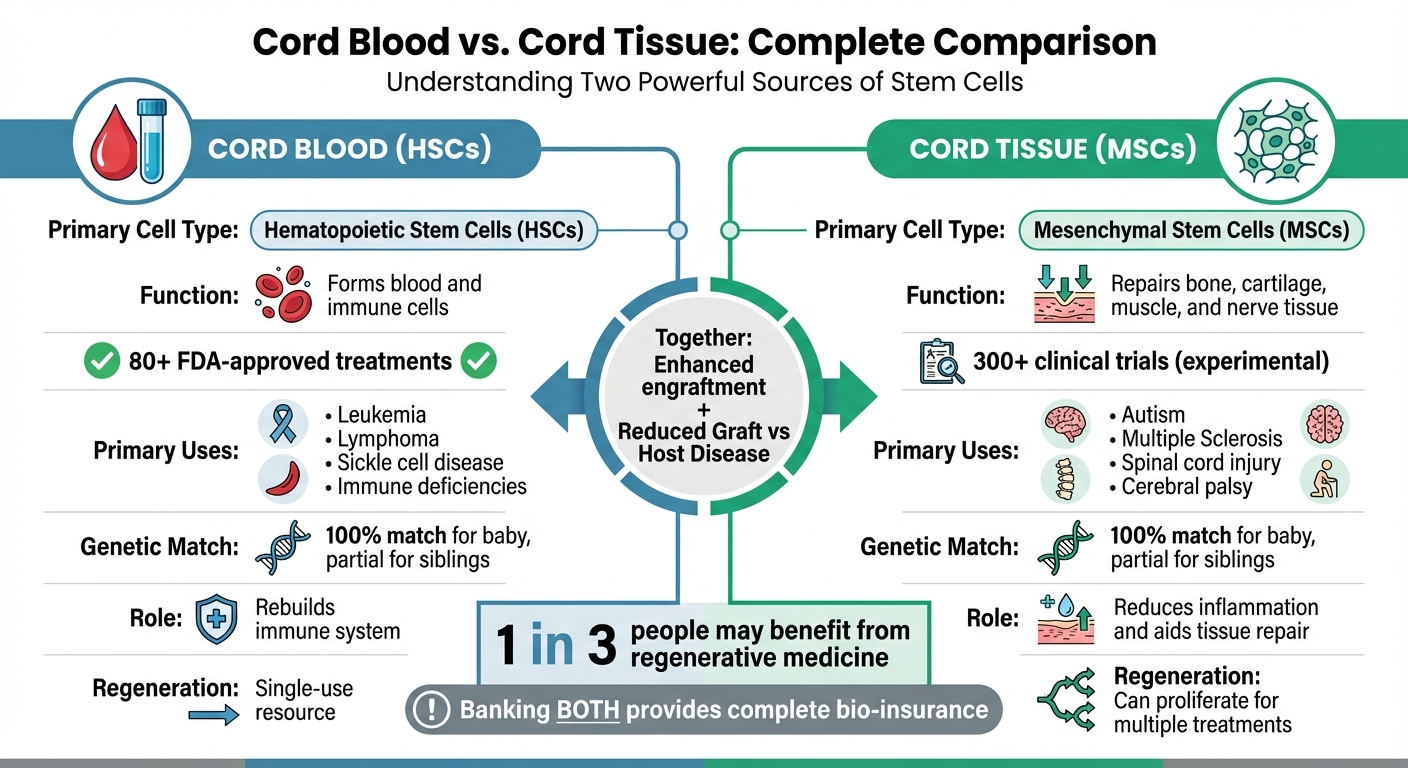
How They Work Together
Cord blood and cord tissue serve different but complementary roles in regenerative medicine. Cord blood contains hematopoietic stem cells (HSCs), which are critical for rebuilding blood and immune systems. These cells are widely used to treat cancers such as leukemia and lymphoma. On the other hand, cord tissue is rich in mesenchymal stem cells (MSCs), which specialize in repairing structural damage to bones, cartilage, muscles, and nerves.
When combined, HSCs and MSCs can significantly improve treatment outcomes. For example, research highlights that co-transplanting MSCs with HSCs not only enhances engraftment success but also reduces the likelihood of Graft vs. Host Disease. Additionally, MSCs can expand HSCs outside the body, increasing the potential of cord blood for treating adult patients.
"The co-transplantation of HSCs with MSCs improves the likelihood of engraftment, the time to engraftment and reduces the risk of Graft vs Host Disease without increasing safety concerns." – Americord Registry
By banking both cord blood and cord tissue, families are prepared for a wide range of current FDA-approved treatments while staying ready for emerging regenerative therapies. With projections indicating that 1 in 3 people could benefit from regenerative medicine during their lifetime, storing both resources offers a comprehensive safety net. The table below highlights their key differences and unique benefits.
Comparison Table
| Feature | Cord Blood (HSCs) | Cord Tissue (MSCs) |
|---|---|---|
| Primary Cell Type | Hematopoietic Stem Cells | Mesenchymal Stem Cells |
| Biological Function | Forms blood and immune cells | Repairs bone, cartilage, muscle, and nerve tissue |
| Current Status | 80+ FDA-approved treatments | 300+ clinical trials (experimental) |
| Primary Medical Uses | Leukemia, lymphoma, sickle cell disease, immune deficiencies | Autism, MS, spinal cord injury, cerebral palsy |
| Genetic Match | Exact match for the baby; partial match for siblings | Exact match for the baby; partial match for siblings |
| Therapeutic Role | Rebuilds immune system | Reduces inflammation and aids tissue repair |
| Regeneration Potential | Single-use resource | Can proliferate for multiple treatments |
Why Bank Both with Americord Registry?

Dual banking with Americord Registry combines the advantages of cord blood and cord tissue preservation, creating a comprehensive bio-insurance strategy that supports both current and emerging medical treatments.
Complete Coverage with Americord Registry
Americord makes dual banking simple and effective with its proprietary CryoMaxx™ Processing. This method is designed to maximize the recovery of stem cells from cord blood while also preserving cord tissue. This dual approach provides families access to both hematopoietic stem cells (used in treating blood disorders) and mesenchymal stem cells (used in regenerative therapies).
All samples are stored in a state-of-the-art laboratory in New Jersey, which is AABB-accredited, FDA-registered, and CLIA-certified. Units are cryogenically preserved at -196°C in specialized cryo-bags, with around-the-clock monitoring and an emergency response system to ensure the safety of every sample. This meticulous process ensures optimal preservation and protection.
Americord also takes a unique approach to cord tissue storage, preserving it as intact membrane sheets across multiple vials. This method maintains the bioactive factors within the tissue, making it adaptable for various future applications.
"Americord's unique CryoMaxx™ Processing method uses a minimal manipulation method and preserves the tissue as sheets in multiple vials. This enables the cord tissue to retain its inherent multipotent cells, growth factors, and cytokines and ensures the potential for multiple uses or applications." – Americord Registry
To provide additional peace of mind, Americord offers an industry-leading $110,000 engraftment guarantee, which covers financial costs if a cord blood transplant does not engraft. With over 22,000 cryogenically stored units as of 2023, Americord has built a strong reputation for reliability and quality in stem cell preservation.
Conclusion: Protect Your Family's Future with Dual Banking
Dual banking creates a robust biological safety net for your family. With regenerative medicine potentially benefiting 1 in 3 Americans, this approach ensures access to both hematopoietic stem cells for blood-related conditions and mesenchymal stem cells for tissue repair and regeneration.
It’s not just about future possibilities - dual banking offers immediate access to over 80 FDA-approved treatments while preparing your family for advancements being explored in 300+ clinical trials.
The $110,000 engraftment guarantee provides added financial security, and with more than 22,000 stored units, the reliability of this service is well-established.
"Banking both cord blood and cord tissue presents an exceptional opportunity to secure a diverse range of life-saving stem cells and regenerative resources for your baby's future." – Americord Registry
FAQs
Who in my family can use banked cord blood or cord tissue?
Banked cord blood can potentially benefit the baby, siblings, or even other relatives, depending on tissue compatibility and specific medical needs. It contains hematopoietic stem cells (HSCs), which are used in the treatment of over 80 conditions, including leukemia and sickle cell disease. Additionally, cord tissue contains mesenchymal stem cells (MSCs), known for their regenerative properties. These cells might play a role in future therapies for family members, as long as there’s a match and a medical necessity.
How long do cord blood and cord tissue samples stay usable in storage?
Cord blood and cord tissue samples can be preserved indefinitely if stored under the right cryogenic conditions. When maintained properly, they retain their potential for use in medical treatments, even years down the line.
When would I actually need both cord blood and cord tissue?
You may want to consider storing both cord blood and cord tissue to preserve a broader range of stem cells. Cord blood is rich in hematopoietic stem cells (HSCs), which are already used in various treatments today. On the other hand, cord tissue contains mesenchymal stem cells (MSCs), which are currently being researched for potential future therapies. By banking both, you expand the possibilities for regenerative and healing uses, providing a more complete form of biological protection for your family.
The views, statements, and pricing expressed are deemed reliable as of the published date. Articles may not reflect current pricing, offerings, or recent innovations.


