

How Stem Cell Banking Supports Family Health
Stem cell banking is a one-time opportunity to preserve your newborn's stem cells at birth, offering a future medical resource for your family. These cells can treat over 80 conditions, including blood disorders, immune diseases, and genetic conditions like sickle cell disease. They may also support emerging treatments currently in clinical trials, such as autism and cerebral palsy therapies.
Key Points:
- Stem cells are collected from cord blood, cord tissue, and placental tissue immediately after delivery.
- They are a genetic match for your baby and potentially compatible with siblings or family members.
- Private banking ensures exclusive access, avoiding the high costs of public bank retrieval.
- Plans like Americord’s offer advanced processing, long-term storage, and financial guarantees.
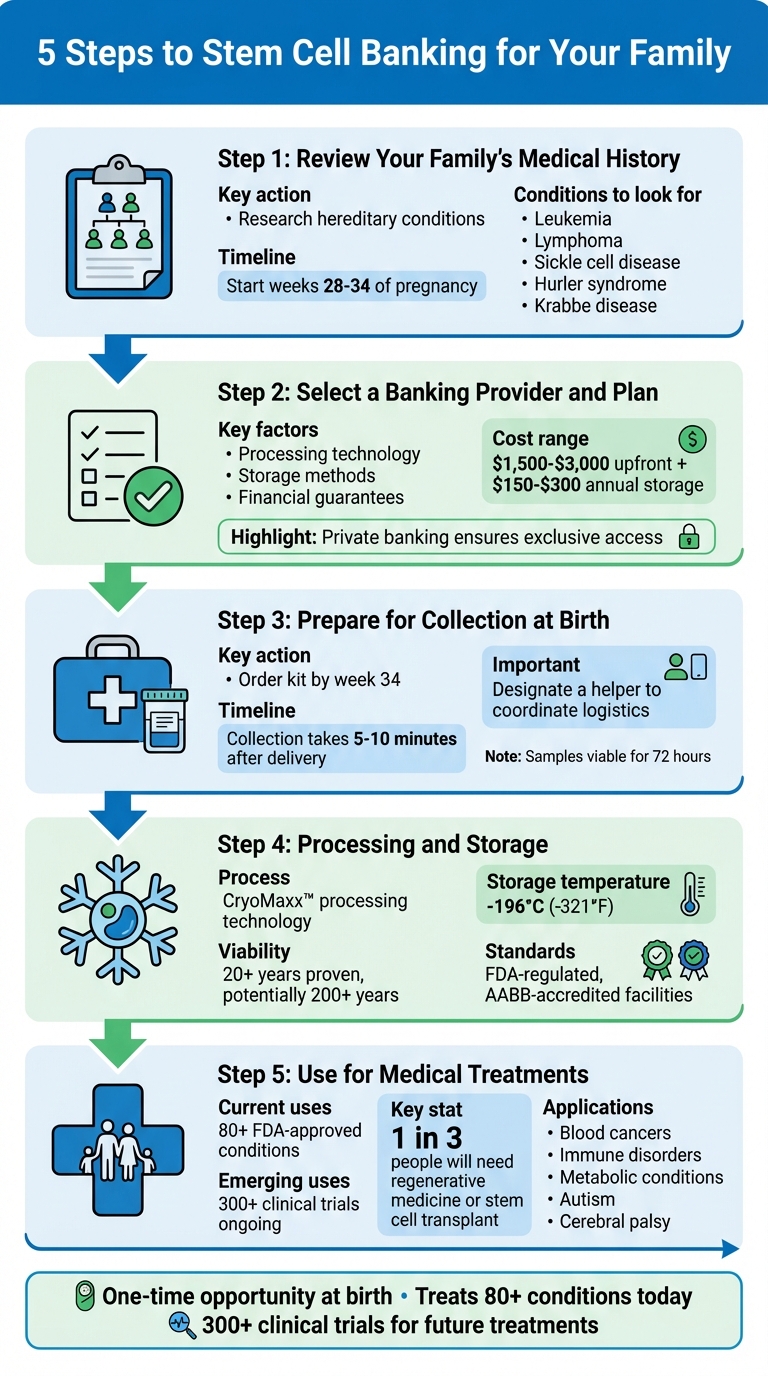
Step 1: Review Your Family's Medical History
Before your baby arrives, take some time to look into your family's medical history. Pay close attention to hereditary conditions like leukemia, lymphoma, sickle cell disease, Hurler syndrome, or Krabbe disease. These illnesses are linked to genetic mutations, and stem cells from cord blood could play a role in targeted treatments.
Start this process early in your pregnancy. This gives you enough time to explore options and coordinate with the best cord blood bank, as the opportunity to collect newborn stem cells is short. Share your findings with your healthcare provider to identify which conditions in your family history might benefit from stem cell therapies. This step is crucial for planning the best stem cell banking approach for your family. Early discussions with your provider can help integrate stem cell banking into your overall medical plan.
Diseases That Stem Cells Can Treat
Stem cells are already being used to treat over 80 conditions, with more applications being explored in clinical trials. The type of treatment depends on whether the condition is inherited or acquired. For genetic disorders like sickle cell disease or cystic fibrosis, a child might need a sibling's stem cells (allogeneic transplant) because their own cells carry the same genetic mutation. For conditions like neuroblastoma, the child could use their own stored cells (autologous transplant).
Knowing the difference between these treatment types can help you understand how stem cells might benefit your family.
| Condition Category | Specific Diseases | Transplant Type Required |
|---|---|---|
| Blood Cancers | Leukemia, Lymphoma, Myelodysplastic Syndromes | Allogeneic or Both |
| Blood Disorders | Sickle Cell Disease, Fanconi Anemia, Thalassemia | Allogeneic |
| Immune Disorders | SCID, Wiskott-Aldrich Syndrome, Kostmann Syndrome | Allogeneic |
| Metabolic Disorders | Hurler Syndrome, Krabbe Disease, Adrenoleukodystrophy | Allogeneic |
| Clinical Trials | Autism, Cerebral Palsy, Type 1 Diabetes | Both |
How Stored Stem Cells Can Help Family Members
Once you've identified conditions in your family history, think about how stored stem cells might help other family members. Your baby's stored stem cells are a perfect match for them, but they could also benefit siblings. Siblings with the same biological parents have the best chance of being a close genetic match. Cord blood transplants are more flexible than bone marrow transplants, as they don't require as strict a match, making them a practical option for treating family members.
Step 2: Select a Stem Cell Banking Provider and Plan
Choosing the right stem cell banking provider and plan is a key step tailored to your family's needs. You'll want to consider factors like processing technology, storage methods, and financial protections. Providers that use advanced processing techniques ensure the highest stem cell yield, which is crucial for future treatments.
When comparing providers, look at their processing methods, storage techniques, and financial safeguards, such as guarantees that cover alternative stem cell sources if your sample doesn't meet the required standards.
Americord Registry stands out with its structured plans and proprietary processing methods designed to maximize stem cell utility.
Step 3: Prepare for Stem Cell Collection at Birth
Once you've chosen your plan, it's time to get ready for the stem cell collection during delivery. The process is quick, painless, and won't interfere with your birth experience. With proper planning and communication, most families find it goes smoothly, allowing them to focus on welcoming their new baby.
Start preparing between weeks 28 and 34 of pregnancy. Order your collection kit at least six weeks before your due date. Keep it unopened and stored at room temperature, then pack it with your hospital bag. Be sure to complete all necessary paperwork, like service agreements and consent forms, well ahead of time to avoid any last-minute stress.
Designate a helper - this could be your partner, a family member, or even your doula. Their job will be to handle the logistics: bringing the kit to the hospital, informing the medical team when labor begins, and contacting the courier service immediately after collection. Save the storage bank's 24/7 contact number and courier details in multiple phones for easy access.
These steps will ensure the collection process fits seamlessly into your delivery day.
How Stem Cells Are Collected
The collection takes place right after delivery and only lasts 5 to 10 minutes. Once the baby is born and the umbilical cord is cut, your OB-GYN or midwife will collect blood from the cord. Depending on your plan, they may also collect cord tissue and placental tissue. This process is completely safe and painless for both you and your baby since the blood is taken after the cord has been detached.
If you're considering delayed cord clamping - recommended by ACOG for 30 to 60 seconds - discuss this with your doctor during your second trimester. While delayed clamping offers benefits to your baby, it might reduce the amount of blood available for collection. Your healthcare provider can help you weigh both options. Once collected, the samples remain viable for up to 72 hours, giving you enough time for the courier to transport them to the lab.
Good coordination with your healthcare team will ensure everything goes smoothly after the collection.
Working with Your Healthcare Team
Clear communication with your healthcare team is key to a successful collection. During your second trimester, inform your OB-GYN or midwife about your plans for stem cell banking. Also, contact your hospital's labor and delivery department ahead of time to confirm they support collection services and to check for any additional fees or specific protocols.
Include "Stem Cell Collection" in your written birth plan, and hand the collection kit directly to the medical professional performing the procedure. After the collection, make sure all containers are labeled correctly with your baby's full name, date of birth, hospital ID, and the exact time of collection. Then, have your designated helper call the courier immediately to arrange pickup.
| Coordination Task | Timing | Responsibility |
|---|---|---|
| Select Bank & Order Kit | By Week 34 of pregnancy | Parents |
| Sign Informed Consent | Before labor begins | Parents & Physician |
| Notify Medical Team | Upon hospital admission | Parents or Helper |
| Perform Collection | Immediately after birth | OB-GYN or Midwife |
| Call Medical Courier | Immediately after packaging | Helper |
In the event of a delivery emergency, remember that your healthcare team will always prioritize your safety and your baby's well-being over the collection process. Your health comes first.
Step 4: Learn How Stem Cells Are Processed and Stored
Once you've prepared for collection at birth, the next vital step is understanding how stem cells are processed and stored. These steps are critical to maintaining the cells' long-term usefulness, ensuring they're ready to serve as a dependable medical resource for your family when needed.
CryoMaxx™ Processing Technology
At Americord Registry, stem cell processing is a hands-on procedure tailored to each collection. This personalized approach allows technicians to optimize stem cell recovery. During processing, red blood cells are removed, and the sample’s volume is reduced to concentrate the essential stem cells.
The CryoMaxx™ method is designed to minimally alter cord tissue and placental tissue, preserving the naturally occurring multipotent cells, growth factors, and cytokines. For cord blood, the processed sample is stored in Americord's proprietary 5-compartment storage bag. Unlike the standard two-compartment design, this setup enhances the potential for multiple treatments in the future.
Long-Term Cryogenic Storage
After processing, the stem cells are frozen at an ultra-low temperature of -196°C (approximately -321°F) in nitrogen-cooled tanks. At this temperature, cellular activity is essentially halted, allowing the cells to remain preserved indefinitely. Research shows that stem cells stored for over 20 years maintain high recovery rates, and some experts suggest that proper cryogenic storage could keep cells viable for more than 200 years.
Americord's storage facility adheres to FDA regulations and holds AABB accreditation, ensuring top-tier safety and quality standards. The facility is equipped with continuous monitoring systems to track temperature and environmental conditions, and an emergency response team is always on standby to protect samples in case of equipment failure or natural disasters. To further ensure peace of mind, Americord offers a $110,000 Cord Blood Quality Guarantee, covering the cost of alternative stem cell sources if the stored cells fail to engraft during a transplant.
Once processed and securely stored, your baby's stem cells are ready to support future medical treatments, providing a lasting safeguard for your family’s health.
Step 5: Use Stored Stem Cells for Medical Treatments
Once your baby's stem cells are preserved, they become a resource you can rely on for medical treatments. If a need arises, simply reach out to Americord Registry to begin the retrieval process. Their team will manage the necessary paperwork, work with your healthcare provider, and ensure the secure transfer of the stem cells to the treatment facility. These cells can be used for your child (autologous use) or for a sibling or family member (allogeneic use), depending on the specific medical situation and genetic match. This process connects the decision to bank stem cells with real-world treatment options when they’re needed most.
FDA-Approved Stem Cell Treatments
Hematopoietic stem cells from cord blood are currently used to treat over 80 conditions, including blood cancers like leukemia and lymphoma, immune system disorders, inherited metabolic conditions, and blood disorders such as sickle cell disease and thalassemia. For many severe illnesses, stem cell transplants are either the only available treatment option or a critical backup when other therapies fail. These FDA-approved treatments are widely recognized, and many insurance providers cover them as standard care.
Emerging Medical Applications
Beyond the established treatments, exciting clinical trials are pushing the boundaries of how stem cells can be used. Over 300 trials are investigating new applications for mesenchymal stem cells derived from cord and placental tissues. These studies are exploring treatments for conditions like autism, cerebral palsy, Type 1 diabetes, heart disease, and Alzheimer's. While these uses are still in the experimental phase, families can gain access by participating in clinical trials conducted by leading research institutions.
For example, in January 2019, a 5-year-old girl named Olivia participated in a clinical trial for autism. She received a 15-minute infusion of her own banked cord blood stem cells. Following the procedure, her autism severity decreased from ASD level 2 (mild to moderate) to level 1. Cases like Olivia’s highlight how clinical trials for conditions such as autism, cerebral palsy, and heart disease can open doors to new treatment possibilities. Since 2008, Americord has released 12 units for treatments, supporting families both through standard therapies and participation in clinical trials.
Banking stem cells today can turn early planning into a long-term resource for addressing future health challenges.
Conclusion: Prepare for Your Family's Health with Stem Cell Banking
Stem cell banking offers a one-time opportunity to secure a biological safety net for your family. By preserving cord blood, tissue, and placental cells, you open the door to treatment possibilities for your child - and potentially other family members. These cells are already used to treat over 80 diseases, and with clinical trials pushing boundaries, they may provide solutions for conditions we can't yet address.
Did you know 1 in 3 people will need regenerative medicine or a stem cell transplant at some point in their lives? That makes early collection a powerful choice for your family's future. With Americord Registry, you get CryoMaxx™ processing, 5-compartment storage, and a $110,000 engraftment guarantee - all designed to ensure your family is prepared for both current treatments and emerging therapies.
It’s important to note that the chance to collect these cells only happens at birth. Families with a history of blood disorders, cancer, or genetic conditions stand to benefit the most. But even beyond that, the rapid advancements in regenerative medicine mean the cells you store today could someday treat conditions we’re just beginning to understand. Americord’s lifetime storage plans, spanning 78 years, ensure your family has access to these cells well into the future, potentially supporting treatments for age-related conditions as they arise.
FAQs
Can my baby use their own banked stem cells later?
Yes, your baby could potentially use their own preserved stem cells in the future for medical treatments. These stored cells might play a role in regenerative medicine or other therapies, depending on the specific condition and advancements in medical science.
Will delayed cord clamping affect collection?
Delayed cord clamping and cord blood collection can be compatible when handled correctly. For instance, delaying clamping by 30–60 seconds provides enough time for stem cell collection without drastically lowering the cord blood volume. Collaborating with your healthcare provider is key to ensuring both practices are managed efficiently.
How long do banked stem cells stay usable?
When stem cells are preserved through cryopreservation, they can remain usable without any time limit. The freezing process effectively pauses cell development and safeguards them from damage, ensuring they retain their potential for use throughout a lifetime.
The views, statements, and pricing expressed are deemed reliable as of the published date. Articles may not reflect current pricing, offerings, or recent innovations.


