

Safe Sleep Fundamentals: How to Secure Your Newborn’s Crib and Nursery
About 3,700 babies die each year in the U.S. from sleep-related causes like SIDS. If I want the short answer, it’s this: I put my baby alone, on their back, and in a bare, firm crib, bassinet, or play yard that meets current U.S. safety rules.
Here’s the full picture in plain terms:
- Alone: no blankets, pillows, bumpers, toys, pets, or bed-sharing
- Back: every nap and every night, through age 1
- Crib: flat, firm, snug mattress, and one fitted sheet only
- No unsafe surfaces: no couch, adult bed, swing, bouncer, lounger, or inclined sleeper
- Safe nursery setup: crib away from windows, cords, wall shelves, and heat sources
- Room check: keep the nursery around 68–72°F
- Weekly crib check: tighten hardware, inspect slats, and check mattress fit
A few product rules matter too. I avoid drop-side cribs, check for recalls, skip any crib item that adds padding, and keep monitor cords and curtain cords far from the sleep space.
If I remember one thing, it’s this: a flat, firm, empty crib lowers risk the most. Everything in this guide points back to that.
Build a Safe Crib Setup
Choose a Crib That Meets Current U.S. Safety Standards
Start with the crib itself. Check for a label showing it meets CPSC rules for full-size cribs (16 CFR 1219) or non-full-size cribs (16 CFR 1220). Then look up the model on SaferProducts.gov to see whether it has been recalled.
There’s one hard rule here: never use a drop-side crib. The U.S. banned them on June 28, 2011, because the sliding rail can fail and create a gap that may trap or suffocate a baby. That’s why older hand-me-down cribs can be risky, especially anything made before the 2011 ban.
A few physical checks can tell you a lot:
- Test the slat spacing. If a soda can fits between the slats, the gap is too wide, and a baby’s head could get stuck.
- Check the headboard and footboard for cutout designs. Those openings can create the same trapping risk.
- Look at the corner posts. They shouldn’t stick up enough to catch clothing.
Use a Firm Mattress With One Fitted Sheet Only
Once the crib frame checks out, move to the mattress. Use a firm, flat mattress made for that crib model, and make sure there are no gaps around the edges.
Press down in the center. It should spring back right away. Then do the two-finger test: slide two fingers between the mattress edge and the crib frame. If two fingers slip in easily, the gap is too wide. The mattress should fit snugly on all four sides with almost no extra space.
The only bedding that belongs in the crib is one tight-fitting sheet made for that exact mattress size. Nothing else.
Do a Simple Weekly Crib Safety Check
After assembly, put the crib on a weekly check schedule.
| What to Check | What to Do |
|---|---|
| Screws, bolts, and brackets | Retighten anything that has loosened; replace missing hardware right away |
| Slats and rails | Check for new cracks, splinters, or movement in individual slats |
| Mattress fit | Repeat the two-finger gap test on all four sides |
| Crib interior | Remove any new soft items, toys, or loose objects |
Keep the Sleep Space Bare
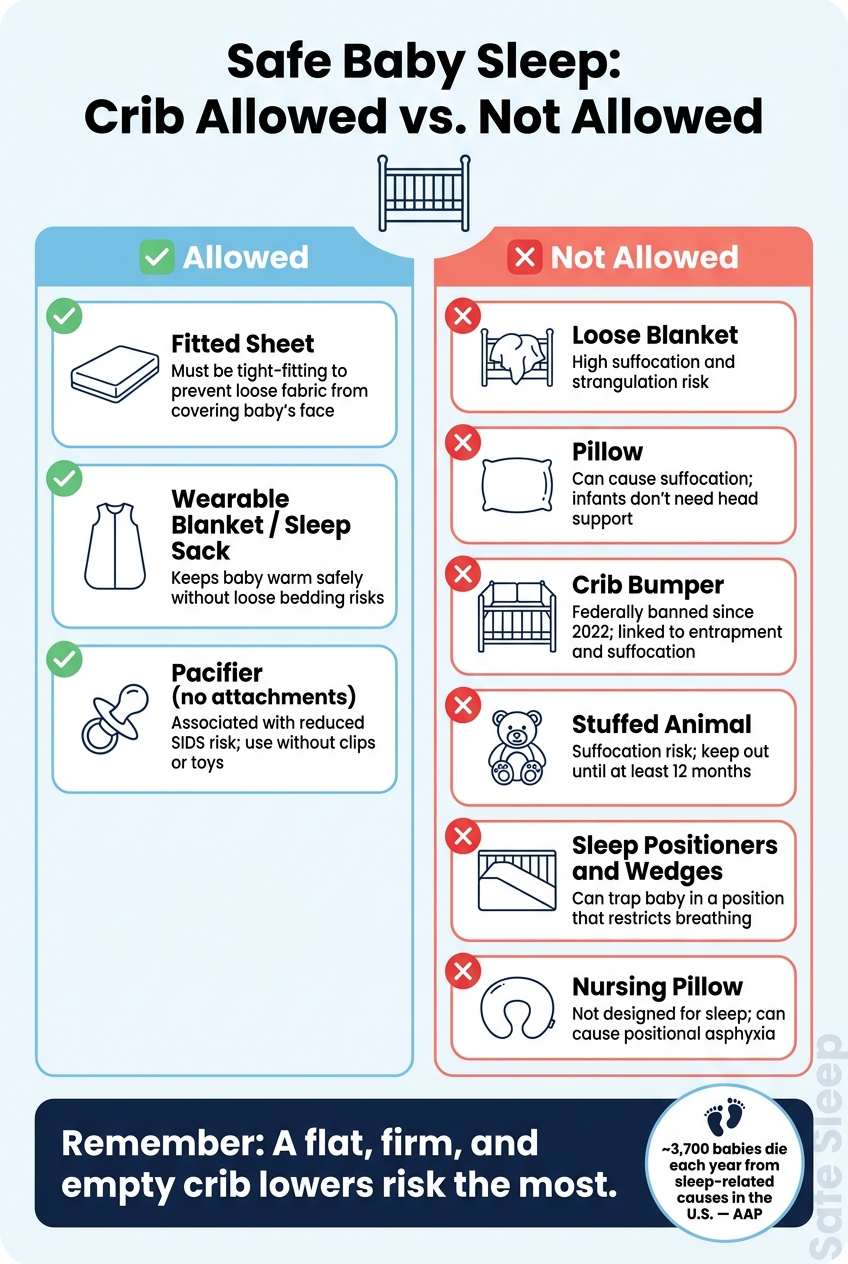
Once the crib is set up, keep it empty except for your baby.
What Can Stay in the Crib During Sleep
Your baby should be the only thing in the crib during sleep. If your baby needs warmth, use a wearable blanket or sleep sack instead of loose bedding.
A pacifier is okay at nap time or bedtime. Just use it on its own, with no clips, strings, or attached toys.
Anything else should stay out of the crib.
What Should Never Go in the Crib
Keep these items out: loose blankets, pillows, bumpers, stuffed animals, toys, nursing pillows, sleep positioners, wedges, and inclined sleepers.
Crib bumpers should come out, including mesh bumpers. Sleep positioners, wedges, and inclined sleepers should come out too. These items can trap a baby or block breathing.
Crib Items: Allowed vs. Not Allowed
| Item | Allowed or Not Allowed | Reason |
|---|---|---|
| Fitted Sheet | ✅ Allowed | Must be tight-fitting to prevent loose fabric from covering the baby's face |
| Wearable Blanket | ✅ Allowed | Keeps baby warm safely without the risks of loose bedding |
| Pacifier | ✅ Allowed (no attachments) | Associated with reduced SIDS risk; use without clips or attached toys |
| Loose Blanket | ❌ Not Allowed | High risk of suffocation or strangulation if it covers the baby's airway |
| Pillow | ❌ Not Allowed | Can cause suffocation; infants don't need head support |
| Crib Bumper | ❌ Not Allowed | Federally banned since 2022; linked to entrapment and suffocation |
| Stuffed Animal | ❌ Not Allowed | Poses a suffocation risk; keep out until at least 12 months |
| Sleep Positioners and Wedges | ❌ Not Allowed | Can trap a baby in a position that restricts breathing |
| Nursing Pillow | ❌ Not Allowed | Not designed for sleep; can lead to positional asphyxia |
Place Your Baby Safely for Every Sleep
A bare crib is only part of safe sleep. How you place your baby matters just as much as what’s in the crib.
Always Put Your Baby on Their Back to Sleep
Place your baby on their back for every sleep - every nap, every night - until they turn 1 year old.
Back sleeping does not increase choking risk for healthy newborns.
If your baby rolls over before they can roll both ways, place them back on their back.
Once your baby can roll from back to front and from front to back on their own, you can leave them in the position they settle into.
Only Use a Flat, Firm Sleep Surface
Use only a flat, firm crib, bassinet, or play yard that meets CPSC standards. Soft or angled sleep surfaces are not safe.
| Sleep Surface | Safe for Routine Sleep? | Why |
|---|---|---|
| Crib, Bassinet, Play Yard | ✅ Yes | Firm, flat, CPSC-approved |
| Couch, Armchair, Adult Bed | ❌ No | Soft surfaces create suffocation and entrapment risk |
| Car Seat, Swing, Bouncer | ❌ No | Sitting position can block the airway |
| Inclined Sleepers / Loungers | ❌ No | Any incline over 10 degrees is unsafe |
Never prop up the crib mattress. An incline increases risk.
Move a Sleeping Baby to a Safe Surface Right Away
If your baby falls asleep in a car seat, stroller, swing, bouncer, or infant carrier, move them to a crib, bassinet, or play yard as soon as you can. Then place them on their back.
Next, reduce nursery hazards outside the crib, including cords, windows, and monitor placement.
Set Up the Nursery to Lower Sleep-Related Risks
Once the crib is bare and set up the right way, take a look at the rest of the room. A safe crib helps a lot, but the area around it matters too. Dangling cords, heavy wall items, and a room that's too warm can all add risk, even if the crib itself looks perfect.
Keep the Crib Away From Windows, Cords, and Wall Items
Place the crib at least 3 feet from any window. Blind and curtain cords can create a strangulation risk, so keep all cords at least 3 feet from the crib. That includes monitor cables, lamp wires, and humidifier cords. A simple rule works well here: if a cord can reach the crib, it's too close.
Also check the wall above the sleep area. Never hang heavy frames, mirrors, or shelves directly over the crib. It's best to keep that space clear.
Heat sources matter too. Keep the crib at least 2 feet from heating vents or radiators to help cut down the risk of overheating.
Use Monitors, Blackout Curtains, and Sound Machines Without Adding Hazards
Nursery gear can help, but only if it's set up with care. Mount the baby monitor on a wall or shelf, never on the crib rail or anywhere your baby could reach it. Secure monitor cords to the wall with clips or a cord cover so they can't be pulled loose.
For windows, cordless blackout curtains or blinds are the safest pick. If your window coverings do have cords, use cord cleats to keep them secured high and fully out of reach.
Sound machines can help mask noise from the rest of the house, which is nice when the dog barks or someone drops a pan in the kitchen. Put the machine on a dresser or shelf away from the crib, and keep the volume moderate.
After you've dealt with cords and gear, turn to the room itself.
Keep the nursery at 68–72°F. To check whether your baby feels comfortable, touch the chest or neck. Warm and dry is fine. Sweaty or hot means the room or clothing may be too warm.
Nursery Setup: Features, Risks, and Setup Tips
| Nursery Feature | Risk Addressed | Practical Setup Tip |
|---|---|---|
| Crib Placement | Strangulation, overheating | Place at least 3 ft from windows and 2 ft from heat vents or radiators |
| Cord Management | Strangulation | Keep all cords out of reach; secure them to the wall with clips or cord covers |
| Baby Monitor | Cord entanglement | Wall-mounted or shelf-mounted, never on crib rail |
| Blackout Curtains | Cord strangulation | Choose cordless versions or use cord cleats to keep cords out of reach |
| Room Temperature | Overheating | Keep room at 68–72°F; dress baby in one more layer than an adult would wear |
| Wall Décor | Falling object injury | Do not hang heavy frames, mirrors, or shelves above the crib |
| Furniture Anchoring | Tip-over injuries | Secure dressers and bookshelves to the wall with anti-tip straps before baby becomes mobile |
Conclusion: A Safer Nursery Starts With a Firm, Bare Crib
Once you've covered the crib, bedding, sleep position, and nursery setup, safe sleep is mostly about doing the same safe things every time.
It comes down to four basics: a CPSC-compliant crib, a firm mattress, one fitted sheet, and a bare sleep space.
That means every sleep starts with baby on their back in a flat, bare crib. The nursery should follow that same standard, with the room kept at 68–72°F.
A firm, bare crib is a safety choice. Everything else starts there.
FAQs
When can I safely add blankets or toys to the crib?
Keep the crib free of blankets, pillows, stuffed animals, and other soft items for at least the first 12 months. They can increase the risk of suffocation, entrapment, and strangulation.
Your baby’s sleep space should include only your baby and a tightly fitted sheet. If your baby might get cold, use a wearable blanket or sleep sack instead of loose bedding.
What should I do if my baby rolls onto their stomach during sleep?
Always place your baby on their back for every nap and at night. That starting position matters each time they sleep.
If your baby rolls onto their stomach before they can reliably roll both ways, gently turn them back onto their back.
Once your baby can roll both ways on their own, you don’t need to reposition them. But you should still always start sleep on their back.
Keep the crib clear of blankets, pillows, bumpers, and toys.
How can I tell if my crib mattress is firm enough and fits correctly?
Do two simple checks.
Press your hand or elbow firmly into the center of the mattress. It should spring back right away and not keep an indent. Skip pillow-top surfaces and memory foam.
Then use the two-finger rule: if the gap between the mattress edge and the crib frame is wider than two fingers, the mattress is too small and could create an entrapment risk.
The views, statements, and pricing expressed are deemed reliable as of the published date. Articles may not reflect current pricing, offerings, or recent innovations.


