

The Biological Insurance: Why Gen Z Parents Are Banking Stem Cells in 2026
In 2026, Gen Z parents are prioritizing stem cell banking as a proactive way to secure their child’s future health. By storing stem cells from umbilical cord blood, cord tissue, or placental tissue at birth, they’re creating a resource for potential treatments of conditions like leukemia, immune deficiencies, and even emerging therapies in regenerative medicine. This approach reflects their focus on long-term planning and staying ahead of medical advancements.
Key takeaways:
- What it is: Stem cell banking involves collecting and preserving cells from newborns at birth.
- Why it matters: These cells can be used for current treatments and future medical breakthroughs.
- Who it’s for: Gen Z parents, known for data-driven health decisions, are embracing it as a form of biological insurance.
With advancements in regenerative medicine, including FDA-approved therapies and clinical trials, stem cell banking is becoming a practical investment for families aiming to prepare for future medical needs.
How Stem Cells Work and What They Can Do
Stem cells are special cells with a remarkable ability: they can develop into various types of cells throughout the body. When collected at birth - when they’re at their peak - they act as a kind of biological safety net, potentially improving the effectiveness of future medical treatments.
What makes stem cells so exciting is their ability to transform into the types of cells needed to repair or regenerate damaged tissues. This flexibility is why they’re a cornerstone of regenerative medicine, offering the possibility to repair, replace, or rebuild tissues and organs.
Stem Cells from Cord Blood, Cord Tissue, and Placental Tissue
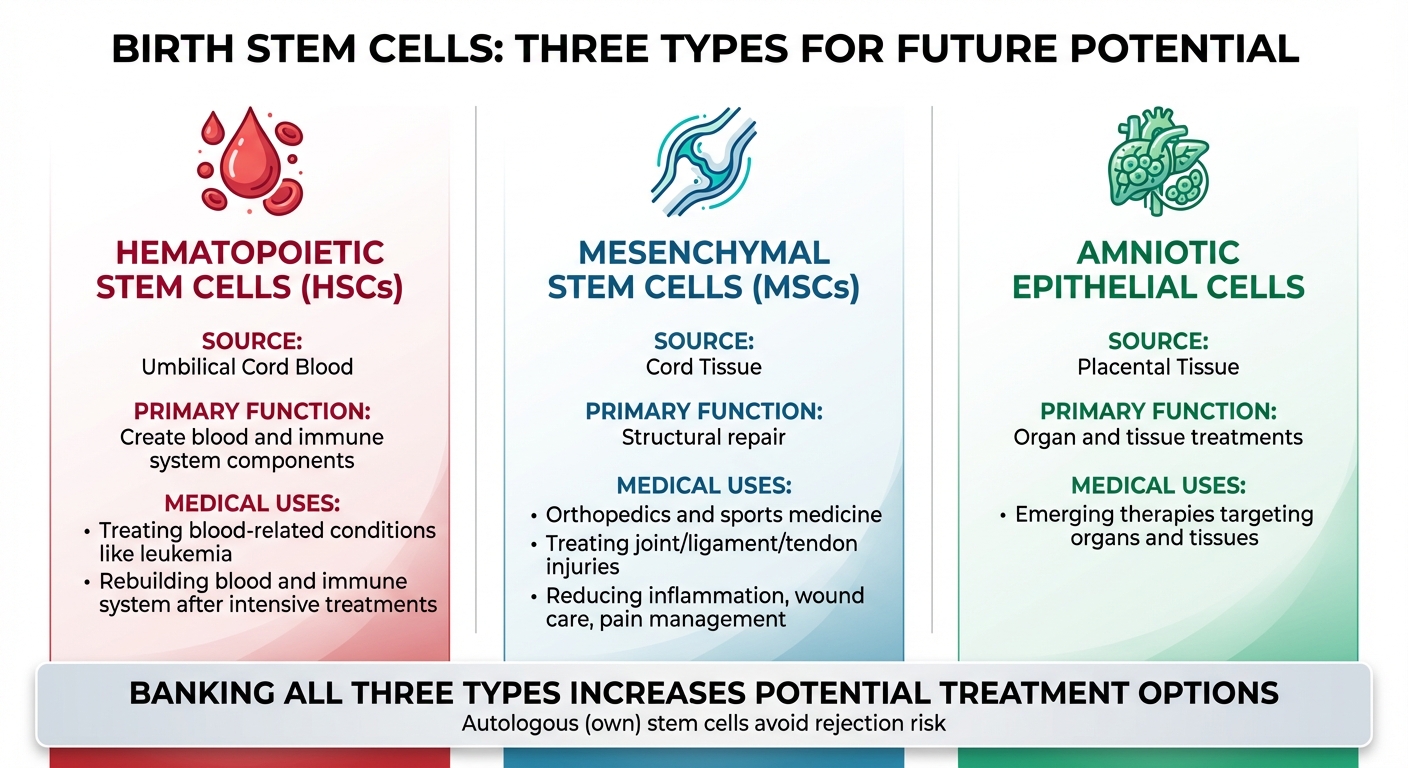
Not all stem cells are the same. At birth, three main types can be collected, each serving a unique role in medicine:
- Hematopoietic stem cells (HSCs): Found in umbilical cord blood, these cells create blood and immune system components. They’re especially useful in treating blood-related conditions like leukemia.
- Mesenchymal stem cells (MSCs): Harvested from cord tissue, these cells are known for their role in structural repair. They’re commonly used in orthopedics and sports medicine to reduce inflammation and aid in healing injuries to joints, ligaments, and tendons.
- Amniotic epithelial cells: Derived from placental tissue, these cells open doors for treatments targeting organs and tissues. Banking all three types increases potential treatment options.
By banking your own (autologous) stem cells, you avoid the risk of rejection, ensuring compatibility if they’re ever needed. These cell types are already making a difference in modern medicine, highlighting their growing importance.
Current Medical Uses for Stored Stem Cells
Hematopoietic stem cells (HSCs) from cord blood are already being used to treat blood disorders like leukemia. After intensive treatments, these cells help rebuild the patient’s blood and immune system.
At Duke University, clinical trials have shown that infusions of a child’s own cord blood can improve motor and social skills in children with cerebral palsy. These findings reflect why many Gen Z parents see stem cell banking as a smart way to invest in their family’s long-term health.
Mesenchymal stem cells (MSCs) from cord tissue are making waves in orthopedics and sports medicine. They’re being used to treat joint, ligament, and tendon injuries by reducing inflammation and encouraging tissue repair. Some doctors are also using them for wound care and pain management. States like Florida, Montana, and New Hampshire have even passed laws broadening access to these therapies.
As medical science progresses, new uses for stem cells continue to emerge. Banking stem cells at birth not only provides access to current treatments but also positions families to benefit from future advancements in regenerative medicine.
Medical and Technology Advances in 2026
Regenerative medicine has officially entered clinical practice in 2026, transforming what once seemed like science fiction into real medical solutions. For parents, this progress highlights the importance of banking stem cells today to access treatments that are reshaping healthcare.
New Developments in Regenerative Medicine
This year has brought groundbreaking progress in regenerative medicine. On March 26, 2026, the FDA granted accelerated approval for Kresladi, the first gene therapy designed for children with severe Leukocyte Adhesion Deficiency Type I (LAD-I). This therapy uses a patient's own hematopoietic stem cells (HSCs), genetically modified to restore immune function. Clinical trials showed promising results - nine children experienced sustained improvements in critical immune biomarkers for 24 months following treatment.
"Today's accelerated approval provides a breakthrough treatment for pediatric patients with severe Leukocyte Adhesion Deficiency Type I - the first FDA-approved gene therapy to treat this disease." - Vinay Prasad, M.D., M.P.H., Chief Medical and Scientific Officer, FDA
Type 1 diabetes is also seeing major advancements. In June 2025, Vertex Pharmaceuticals shared results from the FORWARD-101 Phase 1/2 trial of Zimislecel (VX-880). Twelve participants with Type 1 diabetes reduced their insulin use by an average of 92%, and 83% maintained functional insulin production a year after treatment.
Neurological conditions are now being tackled with stem cell therapies as well. In December 2025, a single dose of NRTX-1001 - stem-cell-derived inhibitory interneurons - was shown to reduce seizures by 58–93% in patients with drug-resistant focal epilepsy. Similarly, Aspen Neuroscience announced in May 2025 that its iPSC-derived therapy improved motor function in Parkinson's patients, with a strong safety profile.
Regulatory changes are also speeding up access to these innovations. Florida, Montana, and New Hampshire passed laws in 2025 and 2026 to expand "Right to Try" programs, allowing licensed physicians to use autologous stem cell therapies for orthopedic and pain treatments. Additionally, the FDA issued updated guidance in September 2025, simplifying trial designs and expediting approvals, ensuring patients benefit from these therapies faster.
Preparing for Your Child's Long-Term Health
These advancements underscore the importance of stem cell banking as a long-term investment in your child’s health. While today’s treatments are impressive, the future holds even more possibilities. Research is already exploring therapies for age-related conditions, vision loss, and muscle deterioration. For example, in January 2026, early findings revealed that stem-cell-derived molecules improved gait speed by 26% in older adults with muscle loss.
"When you bank your baby's stem cells and perinatal tissues, you are giving them a key to unlocking and accessing new treatment options, for their entire life." - Americord Registry
Improvements in cryopreservation and cell culture techniques now mean that a single collection at birth can provide enough cells for multiple treatments throughout a lifetime. Gen Z parents are increasingly recognizing these advancements as part of a proactive approach to ensuring their children’s long-term health.
To maximize the benefits, enrolling by the 34th week of pregnancy ensures optimal cell collection at birth, offering a gateway to future therapies.
Why Gen Z Parents Choose Americord Registry
With the rapid progress in regenerative medicine, Americord Registry equips families with the tools to secure potential future health benefits. Gen Z parents, known for their thorough research and demand for transparency, find Americord aligns with their expectations by offering advanced technology, straightforward pricing, and dedicated customer support.
What Americord Registry Offers
Americord's CryoMaxx™ Processing uses manual methods and minimal manipulation to maximize stem cell recovery while preserving their complete biological profile. This cutting-edge approach ensures samples are ready for both current FDA-approved therapies and future advancements like stem cell expansion.
Safety is a top priority. Americord is AABB-accredited, FDA-registered, and CLIA-certified, with 24/7 monitoring systems and emergency protocols in place to protect over 22,000 cryogenically stored units. They also back their services with a $110,000 engraftment guarantee, covering the cost of securing alternative stem cell sources if a unit fails to engraft.
For pricing, all plans require a $280 collection kit and shipping fee upfront. Starting in April 2026, families can take advantage of discounts - 15% off multi-service 20-year plans and 30% off multi-service lifetime plans. As Josh P., a father of two, shared, "The competitive pricing and attentive specialist exceeded our expectations."
Custom Plans and Customer Support
Americord offers five flexible family plans, allowing parents to choose combinations of cord blood, cord tissue, placental tissue, and exosome banking tailored to their long-term health goals. Storage options are available annually, for 20 years, or for a lifetime (78 years). These plans are designed to adapt to the ever-evolving medical field, ensuring a child’s health is protected well into the future.
To make it even easier, Americord provides 0% interest financing for up to 24 months, accepts health savings and flexible spending accounts, and offers AmeriRush™, which delivers collection kits nationwide within 24–48 hours.
Their customer support stands out with specialized consultants offering free, low-pressure advice via live chat and consultations. This personalized care is reflected in their impressive ratings: 4.8/5 stars on Google Reviews, 4.9/5 on Trustpilot, and a perfect 5/5 on the Better Business Bureau.
Families Who Have Used Stem Cell Banking
How Families Have Used Stored Stem Cells
Families have seen incredible health benefits from banking stem cells with Americord. Take the story of Eli Cola-Achille, a 10-year-old diagnosed with Sickle Cell Disease. In May 2021, Eli underwent a transplant using cord blood and bone marrow stem cells from his younger brother, Gus. These stem cells, stored with Americord at Gus's birth, were used at the Dana-Farber Cancer Institute in Boston. The results? Eli's red blood cell counts returned to healthy levels, and he hasn’t needed a single hospital visit since.
"I'm so thankful for Americord and that Gus's cord blood is the reason his brother is so healthy today."
- Nicole Cola‑Achille, Mother of Eli
Another inspiring case is Olivia Fohs, a 5-year-old with Autism Spectrum Disorder. In January 2019, she received a 15-minute infusion of her own cord blood at Duke University. The improvements were immediate - her autism severity decreased from level 2 (mild to moderate) to level 1. Olivia’s speech, eye contact, and social interaction all showed significant progress.
"We went from her speech therapist telling us she was never going to speak... to her not being eligible for outpatient speech later that year after her stem cell treatment due to them determining it was no longer necessary."
- Amanda Fohs, Mother of Olivia
Americord also partners with leading institutions across the country. Through the Americord Cares program, families with qualifying conditions can access free cord blood banking and lifelong storage.
These personal stories highlight how stem cell banking can make a difference today, while ongoing research continues to expand its potential.
What's Coming in Regenerative Medicine
These success stories are just the beginning. Research led by Dr. Joanne Kurtzberg at Duke University has shown that children with cerebral palsy can benefit from their own stored cord blood, with improvements in motor skills and social abilities. This research hints at even more possibilities for treatments in the years ahead.
Banking stem cells now doesn’t just address current health needs - it opens the door to future medical advances. This is especially important for multi-racial families, as children of mixed-race backgrounds often face difficulties finding matching donors through public registries. By storing their newborn's stem cells, parents ensure a reliable genetic match for any future medical needs, offering peace of mind and hope for what’s to come.
Conclusion: Planning Ahead with Americord
Stem cell banking acts as a safeguard for your child's future health. By storing cord blood, cord tissue, and placental tissue at birth, families gain access to three distinct types of stem cells that can help treat existing conditions and may support therapies still in development.
Today's parents, especially Gen Z, value clarity, digital convenience, and all-in-one solutions. Americord Registry delivers on these needs with FDA-approved treatments, AABB accreditation, and dedicated customer support that walks families through every step of the journey.
Americord offers flexible plans to suit different needs, ranging from the Essential Family Plan, which focuses on cord blood, to the Maximum Family Plan, which includes newborn and maternal exosome banking. Each plan takes advantage of CryoMaxx™ Processing and advanced 5-compartment storage vials, designed to preserve stem cells with maximum viability.
FAQs
Is stem cell banking actually worth it for most families?
Stem cell banking, particularly cord blood banking, is gaining attention as a way to invest in long-term health. It offers access to treatments for more than 80 conditions, including leukemia and sickle cell disease. Additionally, it holds potential for future therapies targeting illnesses like Parkinson’s and diabetes. While it may not be a necessity for every family, many consider it a forward-thinking approach to protecting their child's health for years to come.
Can my child use their own stored stem cells later in life?
Yes, your child can use their own stored stem cells later in life to address certain medical conditions, including those that may arise in adulthood. When cryopreserved, stem cells stay viable for decades, ensuring they are available if needed for future treatments.
What do I need to do before delivery to bank with Americord?
Before giving birth, make sure to include stem cell banking in your birth plan and have your collection kit ready to go. Work closely with your healthcare provider and birthing team to ensure the proper collection of cord blood and tissue. It’s a good idea to review the collection process beforehand and confirm that everything in your kit is set up correctly. Clear and open communication with your medical team will help ensure the collection process goes smoothly right after delivery.
The views, statements, and pricing expressed are deemed reliable as of the published date. Articles may not reflect current pricing, offerings, or recent innovations.


