

The Hidden Danger: A Complete Guide to Heavy Metals in Baby Food
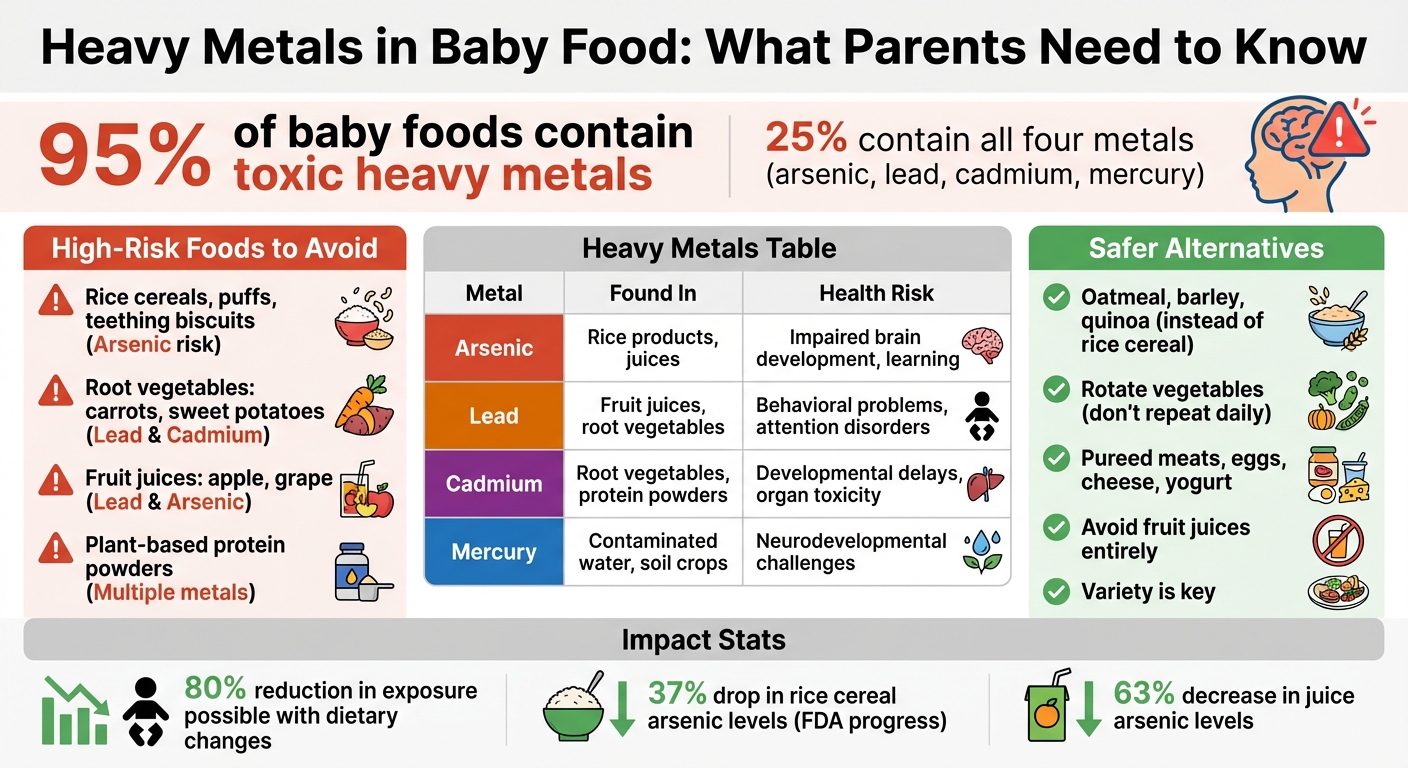
Did you know that 95% of baby foods tested contain toxic heavy metals like arsenic, lead, cadmium, or mercury? Even more alarming, 25% of these products contain all four. These metals, found in both store-bought and homemade baby foods, can harm brain development, reduce IQ, and cause long-term health issues.
Key takeaways:
- High-risk foods: Rice cereals, root vegetables (carrots, sweet potatoes), fruit juices, and plant-based protein powders.
- Health effects: Impaired brain development, learning delays, and attention problems.
- Reducing exposure: Diversify your child’s diet, avoid rice-based products, and choose alternatives like oatmeal or barley.
The FDA’s "Closer to Zero" initiative aims to lower heavy metals in baby food, but parents play a critical role in reducing exposure. Simple changes, like rotating vegetables and avoiding fruit juices, can cut exposure by 80%. Read on for actionable tips to protect your baby’s health.
What Are Heavy Metals in Baby Food?
Heavy metals like arsenic, lead, cadmium, and mercury are naturally occurring elements found in the environment. While they exist in nature, they become harmful when they enter the food supply - especially foods consumed by babies. At elevated levels, these neurotoxins can interfere with a baby’s developing brain and body.
This issue isn’t solely linked to industrial pollution. These metals are present in soil, water, and air, spreading both through natural processes and human activities. Crops absorb these metals as they grow, which is where the contamination begins. As Evelyn Benden, RD, LD from Cleveland Clinic explains:
"Crops that become the food we eat may absorb these heavy metals as they grow. That leaves trace amounts of the metals in the plants we consume."
This means the problem starts before the food even reaches manufacturing facilities. Understanding how these metals enter the food supply is essential to reducing exposure. Let’s look at where these contaminants originate.
Where Heavy Metal Contamination Comes From
Some foods are more likely to contain heavy metals than others. For example, rice-based products - like rice cereal, puffs, and teething biscuits - often have higher arsenic levels because rice plants naturally absorb more arsenic compared to other grains.
Root vegetables, such as carrots and sweet potatoes, are another concern. Since they grow underground, they are in direct contact with soil, making them more prone to absorbing metals from the earth. Fruit juices, particularly apple and grape varieties, have also been found to contain small amounts of arsenic and lead. Meanwhile, plant-based protein powders, especially soy-based ones, are more likely to contain arsenic, cadmium, and lead compared to animal-based options like whey or egg protein.
| Heavy Metal | Common Food Sources | Potential Health Risks |
|---|---|---|
| Arsenic | Rice, rice cereals, fruit juices, plant-based protein powders | Impaired brain development, learning issues |
| Lead | Fruit juices (apple/grape), root vegetables, soil-grown crops | Behavioral problems, attention disorders |
| Cadmium | Root vegetables, plant-based protein powders | Developmental delays, organ toxicity |
| Mercury | Contaminated water, certain fish, soil-grown crops | Neurodevelopmental challenges |
Why Babies Are More Vulnerable
Babies are especially at risk from heavy metal exposure due to their small body sizes. Even tiny amounts of contamination can have a larger impact compared to adults. Their faster metabolisms also mean they absorb more of the contaminants in their food.
The most critical factor is that babies’ brains and organ systems are still developing. Their detox systems are not yet fully functional, making it harder for their bodies to process and eliminate toxins. This increases the potential for harm during these early, formative years. Because of these vulnerabilities, the FDA has made reducing heavy metals in baby food a priority to protect infants from the risks associated with even low-level exposure.
Health Risks of Heavy Metal Exposure in Babies
Heavy metals in baby food pose serious risks to infants' health. These neurotoxins disrupt essential developmental processes during a critical period of growth. Since babies' bodies and brains are still maturing, exposure to these harmful substances can lead to long-term challenges that persist well beyond infancy.
While earlier sections explained how heavy metals end up in baby food, this section focuses on the direct health consequences for infants.
Effects on Brain Development
The most alarming danger of heavy metal exposure lies in its impact on brain development. Heavy metals like arsenic, lead, mercury, and cadmium can significantly harm cognitive abilities. These toxins have been shown to lower IQ levels, cause behavioral problems, and delay learning milestones in children.
"At high levels, these neurotoxins can delay and impair brain development in young children." – Cleveland Clinic
Exposure to heavy metals can result in attention issues, learning difficulties, and other developmental delays. Children exposed to higher levels during infancy may face ongoing struggles with focus and impulse control. Some studies even suggest possible links between heavy metal exposure and conditions like ADHD or autism spectrum disorders, though further research is needed to confirm these connections.
Physical growth is also affected. Heavy metals can slow height and weight development by interfering with nutrient absorption and tissue formation, particularly during periods of rapid growth.
Long-Term Health Consequences
The effects of heavy metal exposure extend far beyond infancy. Developmental delays that begin early can persist into childhood, impacting academic success, social interactions, and emotional well-being. Many children exposed to heavy metals require ongoing support to address learning and behavioral challenges as they grow.
In addition to developmental issues, long-term exposure to heavy metals increases the risk of serious health problems later in life. Research has linked early heavy metal exposure to a higher likelihood of developing cancer and chronic illnesses in adulthood. These toxins can accumulate in the body, leading to lasting damage to organ systems.
Recognizing these dangers, the FDA launched the "Closer to Zero" initiative in 2021, aiming to reduce heavy metals in foods commonly consumed by infants and young children. As Cleveland Clinic highlights:
"The FDA prioritized foods commonly eaten by babies and young children because their smaller body sizes and metabolism make them more vulnerable to the harmful effects of heavy metal exposure."
Because of this heightened vulnerability, even small, repeated exposures to heavy metals can lead to significant health consequences over time.
U.S. Regulations and Testing for Heavy Metals in Baby Food
The health risks tied to heavy metals in baby food make regulatory oversight essential. Under the Federal Food, Drug, and Cosmetic Act, manufacturers are responsible for ensuring food safety, but current practices often fall short. The FDA considers food "adulterated" if toxic elements reach harmful levels. Through its Total Diet Study program, the agency blocked about 65 imports between 2019 and 2020 due to safety concerns.
The FDA sets action levels to determine when recalls or seizures might be necessary. However, critics argue these levels are too lenient, especially given the vulnerability of infants. To address these concerns, the FDA introduced the Closer to Zero initiative, aimed at reducing heavy metal contamination.
FDA Closer to Zero Initiative
In April 2021, the FDA launched the Closer to Zero initiative, a phased plan designed to lower the presence of lead, arsenic, cadmium, and mercury in baby foods to the lowest achievable levels.
"Our goal is to reduce exposure to toxic elements in foods to the greatest extent feasible and to further advance progress in this area through more research and enhanced collaboration among stakeholders." - FDA
Phase 1 of the plan targeted the development of action levels for lead in baby foods by April 2022. While the FDA acknowledges that completely eliminating naturally occurring heavy metals is impossible, the initiative aims to balance safety with affordability by setting realistic thresholds.
Despite these efforts, regulatory measures continue to face scrutiny, especially following findings from recent legislative investigations.
Findings from the 2021 Congressional Report
Two reports from the U.S. House Subcommittee on Economic and Consumer Policy, released in February and September 2021, revealed alarming levels of heavy metals in popular baby foods. For instance, Plum Organics products contained up to 225 ppb of inorganic arsenic, while nearly 40% of tested baby foods exceeded 5 ppb cadmium. Most products also surpassed 5 ppb lead.
The reports uncovered troubling industry practices. In 2018, Walmart raised its internal inorganic arsenic limit from 23 ppb to 100 ppb, without providing a scientific rationale. Additionally, FDA-funded testing in Alaska found that Beech-Nut and Gerber rice cereals exceeded 100 ppb of inorganic arsenic. While Beech-Nut issued a limited recall affecting only two of six problematic products, Gerber did not notify the public or remove its products from shelves.
"Companies not only under-report the high levels of toxic content in their baby food, but also knowingly keep toxic products on the market." - Rep. Raja Krishnamoorthi, Chairman of the Subcommittee on Economic and Consumer Policy
Another major issue is that manufacturers often test individual ingredients rather than finished products. This practice can significantly underestimate the actual heavy metal content in the foods parents feed their children. The findings from these reports have intensified pressure on the FDA to enforce stricter regulations, including mandatory testing of finished products across the industry.
How to Identify and Avoid Contaminated Baby Food
Concerns about contaminated baby food have grown, but there are steps you can take at home to reduce your baby's exposure to heavy metals. Knowing which foods are riskier and how to check for safety can help you make smarter choices. While no baby food is entirely free of contamination, some foods and preparation methods are more worrisome than others. Let’s break down the high-risk foods and how to review labels for safety.
Foods Most Likely to Contain Heavy Metals
Certain types of baby food are more likely to contain heavy metals like arsenic, lead, and cadmium. Here’s what to watch out for:
- Rice-based products: Items like rice cereal, puffs, and teething biscuits often have high arsenic levels. For example, in June 2021, Beech-Nut recalled rice cereal due to excessive arsenic.
- Root vegetables: Carrots and sweet potatoes are more prone to lead and cadmium contamination.
- Fruit juices: Apple and grape juices often contain measurable levels of lead and arsenic.
Recent recalls highlight the risks. In March 2025, Target pulled its Good & Gather "Baby Pea, Zucchini, Kale & Thyme Vegetable Puree" due to high lead levels. Similarly, Publix recalled its GreenWise "Pear, Kiwi, Spinach & Pea Baby Food" pouches in May 2025 for potential lead contamination.
The statistics are unsettling. A 2019 study revealed that 95% of baby food tested contained heavy metals, and in 2021, government tests found lead levels in some baby food up to 177 times the limit allowed in bottled water. This highlights the importance of knowing what to avoid and how to verify safety.
How to Read Labels and Product Information
California’s Assembly Bill 899 has made it easier for parents to access safety information, requiring baby food packaging to include QR codes that link to third-party test results for heavy metals. Scanning these codes can help you confirm whether a product meets safety standards.
"Parents should not have to question whether baby food is safe to eat, and that's why California law requires companies to disclose the presence of heavy metals."
When checking a product, locate the lot number, best-by date (usually on the bottom of jars or back of pouches), and, if needed, the 12-digit UPC code. Use this information with the QR code or the manufacturer’s website to access batch-specific test results. A Consumer Reports and Unleaded Kids review in August 2025 found that while companies like Earth's Best and Once Upon a Farm offered easy access to test results, others, such as Beech-Nut and Sprout Organics, required additional steps like entering lot numbers or dates.
Make sure the testing lab’s detection limit is at least 6 parts per billion (ppb), as required by California law. Some companies use less sensitive equipment that only detects levels down to 10 ppb, which might miss smaller amounts of contamination. Also, check the first three ingredients on the label. Avoid products where rice or root vegetables are listed first or second. Instead, choose options with oats, barley, or a variety of vegetables, which are less likely to contain heavy metals.
Safer Baby Food Options and Preparation Methods
Choosing the right foods and preparing them carefully can make a big difference in reducing exposure to harmful substances in baby food. While no food is completely risk-free, smart choices and proper preparation can significantly lower the chances of contamination.
Lower-Risk Foods and Dietary Variety
One of the best ways to minimize exposure is by offering a variety of foods instead of sticking to the same ones every day. For example, oatmeal, barley, quinoa, and multigrain cereals are great alternatives to rice cereal when introducing solids. For protein, options like pureed meats, eggs, cheese, and yogurt tend to have lower levels of heavy metals compared to rice-based products. When it comes to snacks, skip processed rice puffs and teething biscuits; instead, try mashed fruits, soft vegetables, or even a cold teether.
Root vegetables such as carrots and sweet potatoes are packed with nutrients but can absorb more metals from the soil. To reduce risk, rotate these with other vegetables rather than serving them daily. For hydration, babies under one year should stick to breast milk or formula. If your child is older, avoid fruit juices altogether or limit them to less than half a cup per day, as juices like apple and grape often contain lead and arsenic.
Offering a wide range of foods not only helps limit exposure but also ensures your baby gets balanced nutrition.
"The key is to provide your child with a healthy variety of foods, in moderation, so they aren't eating too much of one thing. They'll get lots of different nutrients and not an overload of heavy metals." - Evelyn Benden, Registered Dietitian, Cleveland Clinic
Making Baby Food at Home
Even when preparing baby food at home, it's important to remember that homemade doesn't automatically mean contaminant-free. Studies have shown that 94% of homemade baby food contains detectable levels of heavy metals, largely because the raw ingredients may already be tainted. However, there are steps you can take to reduce risks.
If you're cooking rice, opt for white basmati or sushi rice, which tend to have lower arsenic levels. Rinse the rice thoroughly before cooking, use extra water during cooking, and drain off the excess to help remove arsenic. Also, make sure to test your tap or well water for contaminants, as water quality can play a big role in food safety.
When selecting foods, focus on whole, unprocessed options such as fresh fruits, vegetables, eggs, and dairy. Avoid processed baby snacks made with refined flours and added salt, and steer clear of plant-based protein powders, which may carry additional risks.
At-Home Testing Kits for Heavy Metals
At-home testing kits allow parents to send baby food samples to accredited labs for analysis, detecting heavy metals down to trace levels. While they involve a bit more effort than just checking labels, they deliver precise results, offering parents added reassurance.
What to Look for in a Testing Kit
When choosing a testing kit, focus on these key features:
- ICP-MS Analysis: Opt for kits that use Inductively Coupled Plasma Mass Spectrometry (ICP-MS) for accurate detection.
- Accredited Labs: Ensure the lab is ISO/IEC 17025 accredited for reliable results.
- Comprehensive Testing: The kit should test for lead, arsenic (specifically identifying the harmful inorganic form), cadmium, and mercury.
- Detailed Results: Look for kits that provide a Certificate of Analysis with clear numerical data.
By keeping these points in mind, you can pick a kit that meets your needs.
Comparison of Popular Testing Kits
There are two main types of at-home testing kits to consider:
- Mail-In Food Testing Kits: These kits analyze food samples using ICP-MS technology. They focus on identifying heavy metals directly in the food your baby consumes.
- Biological Testing Kits: Instead of testing food, these kits measure your baby's exposure to heavy metals through urine or blood spot samples. They also assess levels of key essential elements and have a shelf life of about 30 days.
Both options are reliable, with costs typically ranging between $100 and $300. These kits serve as an additional step in reducing heavy metal exposure, complementing safer food choices and preparation methods you may already be using.
Conclusion
Heavy metals in baby food are a valid concern, but taking informed steps can make a world of difference. While studies reveal that 95% of tested baby foods contain one or more toxic heavy metals, there’s encouraging news: simple dietary changes can cut your baby’s exposure by an average of 80%. The secret lies in knowing which foods pose higher risks and ensuring your child’s diet includes a wide variety of ingredients.
Variety is your best strategy. Registered dietitian Evelyn Benden emphasizes:
"The key is to provide your child with a healthy variety of foods, in moderation, so they aren't eating too much of one thing. They'll get lots of different nutrients and not an overload of heavy metals."
Consider replacing rice cereal with other grains, mixing root vegetables with leafy greens, and keeping fruit juice consumption to a minimum. These small adjustments can significantly reduce potential risks.
What matters most is cumulative exposure. Over time, prolonged exposure can impact early brain development, so whether you’re buying pre-made baby food or preparing it at home, focus on using a diverse range of ingredients to lower the risk.
Efforts like the FDA’s "Closer to Zero" initiative are making strides - arsenic levels in rice cereal have dropped by 37%, and juice arsenic levels have decreased by 63%. However, parents remain the most critical line of defense. By staying informed, reading labels, and even exploring at-home testing when necessary, you can take proactive steps to safeguard your baby’s brain development and overall health.
Every choice counts. Use this information to support your child’s healthy growth and development.
FAQs
How can I tell if a baby food is high in heavy metals?
To find out if baby food contains heavy metals, start by checking for any labeling or testing details provided by the manufacturer. However, keep in mind that this information isn’t always readily available. Stay updated by consulting reliable health resources and avoid items more likely to have contamination, such as rice-based products and certain root vegetables. While home testing kits are an option, use them carefully and with proper guidance. Opting for well-known, trusted brands can also help minimize potential exposure.
What should I feed instead of rice cereal?
Instead of rice cereal, try offering safer and more nutrient-packed options like oats, barley, or multigrain cereals. These typically have lower levels of heavy metals, including arsenic. Pureed fruits and vegetables, such as sweet potatoes, carrots, and apples, are also great choices for your baby. If you’re up for it, making homemade baby food with fresh, organic ingredients can help minimize exposure to contaminants. Just be sure to check with your pediatrician to confirm these alternatives meet your baby’s nutritional requirements.
Should I test my baby or their food for heavy metals?
Testing your baby's food for heavy metals is a smart way to check for contaminants and lower exposure risks. While it's not usually necessary to test your baby directly, you can use home testing kits or opt for professional lab analysis to examine the food itself. Stick to baby food brands known for having lower levels of heavy metals, and follow safe preparation methods to further reduce potential risks. Taking these steps keeps you informed and helps protect your baby's health.
The views, statements, and pricing expressed are deemed reliable as of the published date. Articles may not reflect current pricing, offerings, or recent innovations.


