

What Your Baby Can Actually Feel and Experience by Week 12
At 12 weeks, your baby is far more developed than you might think. Measuring about 3.15 inches and weighing 1 ounce, their sensory and neural systems are already taking shape. Here’s what’s happening:
- Touch: Reflexes like grasping and responding to light touches are active, though conscious sensation won’t develop until later.
- Movement: Stretching, kicking, and even thumb-sucking are common, although you won’t feel these movements yet.
- Organ Growth: Major systems like the heart, kidneys, and liver are functional, with the heart beating 160 times per minute.
- Taste and Smell: Taste buds are forming, and your baby is swallowing amniotic fluid, starting to detect subtle flavors.
- Brain Development: Neural connections are rapidly forming, setting the stage for future sensory processing.
While your baby can respond to stimuli, they lack conscious awareness. This period is crucial for laying the groundwork for growth and future sensory experiences. Take steps to support this development, such as maintaining proper nutrition and considering the benefits of cord blood banking.
Fetal Development at Week 12: Key Milestones
At this stage, your baby is undergoing rapid physical growth and organ development, setting the stage for future milestones.
Fetal Size and Growth
By week 12, your baby measures around 2 to 3.15 inches from crown to rump - roughly the size of a lime - and weighs between 0.5 and 1.5 ounces. During this period, fetal weight jumps by about 58% from week 11 to week 12 and will triple in the following two weeks. Interestingly, the head still makes up about half of the baby’s total body length, while the arms have reached their final proportions. The legs, however, are still catching up. This rapid growth supports the critical organ development happening at this stage.
Critical Organ Development
By week 12, nearly all major organ systems are formed and starting to function. The heart, for instance, has already beaten over 10 million times and currently pumps at a fast rate of 160 beats per minute, nearly twice as fast as an adult heart. The kidneys are now operational, releasing urine into the amniotic fluid, while the liver - making up about 10% of the baby’s total body weight - is busy producing red and white blood cells.
The digestive system is also undergoing big changes. Earlier in development, the intestines grew so rapidly that they extended into the umbilical cord. By week 12, the abdominal cavity has expanded enough to accommodate them. Meanwhile, the thyroid and pancreas have started producing hormones, and the baby’s skeleton is beginning to harden as soft tissue transitions into bone.
"Your baby... is now fully formed, with all of their organs, muscles, limbs and bones in place." - Pregnancy Birth and Baby
Fingerprints are starting to develop, influenced by genetics and the flow of amniotic fluid. These advances in organ systems lay the groundwork for future sensory and neural development.
Why the First Trimester Matters
The first trimester is all about laying the foundation. This process, known as organogenesis, is nearly complete by the end of week 12. From here on, the focus shifts from building organs to growing and refining them.
This period is also when the baby is most vulnerable to external factors like infections, medications, and nutritional deficiencies. To support healthy development, taking 400 micrograms of folic acid daily through at least week 12 is strongly recommended. Folic acid plays a crucial role in forming the nervous system and reducing the risk of neural tube defects, such as spina bifida. Reaching the 12-week mark also brings a sense of relief for many, as the risk of miscarriage - estimated at 15–20% during the first trimester - drops significantly after this point.
How the Sense of Touch Develops at Week 12
By week 12 of pregnancy, the baby's tactile system begins to take shape, building on the rapid development of organs and the nervous system.
How the Nervous System Forms
Touch is the very first sense to develop in the womb. Between weeks 4 and 7, tactile receptors - cutaneous and trigeminal somatosensory receptors - start forming. These receptors, which detect touch on the skin and face, connect to the spinal cord by week 12. During this time, key neurotransmitters involved in pain signaling, such as Substance P and enkephalins, also begin to increase.
With the major organ systems established, the tactile receptors start playing a crucial role in sensory input. At this point, neural projections from the thalamus - the brain's sensory relay hub - begin extending into a temporary structure called the subplate. This subplate temporarily processes sensory signals until the cortex is fully developed. Additionally, the centro-median nucleus of the thalamus, which helps process sensory input and regulate arousal, begins to form during this period.
Reflexive Responses to Touch
By week 12, the fetus shows reflexive responses to light touch across most of its body, except for the back and the top of the head. These reflexes follow consistent patterns:
| Reflex | Trigger | Response |
|---|---|---|
| Plantar (Babinski) | Touch to the sole of the foot | The big toe extends while other toes fan out |
| Palmar Grasp | Touch to the palm | Fingers curl toward the object |
| Orbicularis | Touch to the upper eyelid | Eyes roll downward, and muscles squint |
| Perioral | Touch to the face or lips | Head turns away from the stimulus |
These reflexes demonstrate that the nervous system is already processing and reacting to environmental stimuli. In twin pregnancies, fetuses as early as 11 to 13 weeks have been observed moving in response to touch from their sibling - a fascinating glimpse into how responsive the fetal body is at this stage.
"Touch might well be seen as the sensory scaffold on which multisensory perceptual development is constructed!" - ScienceDirect
However, it's important to note that these reflexes are not the same as conscious sensations.
Reflexes vs. Conscious Sensation
At this stage, reflexive movements are automatic and controlled by the spinal cord and brainstem, not conscious thought. The ability to consciously perceive touch - like adults do - requires mature thalamocortical connections, which don’t begin forming until around week 24.
Week 12 lays the groundwork for sensory responses, building on earlier neural and organ development. Researchers Stuart WG Derbyshire and John C. Bockmann describe this stage as capable of experiencing something they call:
"The evidence, and a balanced reading of that evidence, points towards an immediate and unreflective pain experience mediated by the developing function of the nervous system from as early as 12 weeks."
This "unreflective" sensation suggests that while the fetus can respond to stimuli, it lacks the higher-level awareness or emotional processing associated with mature sensory experiences. Week 12 marks the starting point for sensory development, with much more to come as the nervous system continues to grow.
Fetal Movement and Early Body Awareness at Week 12
By week 12, your baby is already more active than you might expect. Even though you won’t feel these movements just yet, your baby is busy stretching, kicking, and exploring, laying the groundwork for their tactile and neural development.
Common Movements Seen at Week 12
Ultrasound scans at this stage often show a baby that’s full of energy. You might see them stretching, yawning, kicking, punching, or even clenching their tiny fists. The sucking reflex is already in action, and swallowing amniotic fluid begins around this time. Some babies even bring their hands to their faces or start sucking their thumbs.
Here’s an interesting fact: about 90% of fetuses show a preference for moving their right arm and turning their head to the right by this week. This early preference hints that handedness begins developing well before birth.
While most mothers won’t feel these movements until weeks 16 to 20, the 12-week ultrasound often offers the first chance to witness just how active your baby already is. These movements aren’t just random reflexes - they’re part of the process that helps your baby begin to understand their own body.
Early Proprioception and Body Mapping
Your baby’s movements at this stage are more than just reflexes; they’re the first steps toward early body awareness. Researchers call this "motor babbling" - spontaneous movements that help the fetus explore both their body and environment.
Self-touch plays a crucial role in this process. For example, when a baby’s hand touches their face, it provides double tactile feedback: the hand feels the face, and the face feels the hand. This dual sensation helps the brain begin to distinguish between "self" and "not self", forming the foundation for a basic body map.
"The fetus's first motor activity allows it to feel the space around it and to feel its body and the consequences of its movements on its body." - Jaqueline Fagard et al., Frontiers in Neurorobotics
Repetitive movements, like touching the face or mouth, are particularly important. These actions help the brain link specific motions to specific sensations, gradually building sensorimotor awareness. As noted in Advances in Child Development and Behavior:
"Touch is the first of our senses to develop, providing us with the sensory scaffold on which we come to perceive our own bodies and our sense of self."
Although this body mapping is just beginning at week 12, the patterns being established now will continue to evolve throughout pregnancy and beyond.
What a Baby Can and Cannot Feel at Week 12
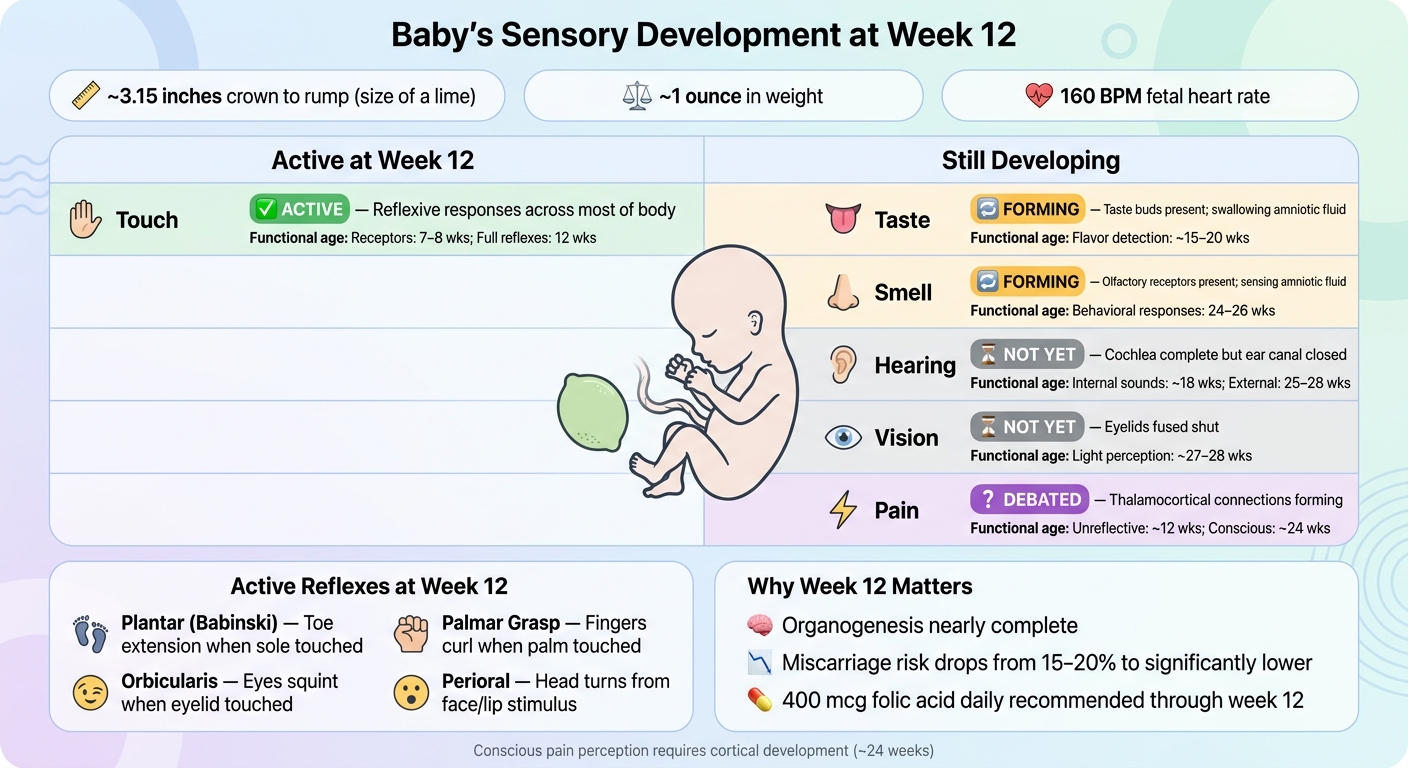
Which Senses Are Active at Week 12
At 12 weeks, the baby's tactile system is the most advanced, laying the foundation for early sensory development. Reflex patterns are already established across much of the body, showcasing the progression of neural growth. While touch is well-developed, other senses are still in earlier stages of formation, each following its own timeline.
Taste and smell are beginning to emerge. Taste buds are formed, and the baby is already swallowing amniotic fluid, which carries flavor molecules from the parent's diet. This means the baby is starting to encounter subtle chemical sensations. Olfactory receptors, which appeared as early as week 8, add to this early sensory experience by detecting the chemical makeup of the fluid being swallowed and "breathed."
Hearing and vision, however, are still in their infancy. Although the cochlea is fully formed, the ear canal remains closed, so sound detection won't begin until around week 18. As for vision, the eyelids are fused shut, and the baby won't start perceiving light until much later. The functional progression of these senses is summarized in the table below.
What Science Can and Cannot Tell Us
When it comes to pain, the science becomes more intricate. By week 12, the thalamus - the brain's sensory relay center - starts forming connections with other parts of the brain. Some researchers believe these connections enable the processing of "unreflective pain", which refers to raw sensory responses without conscious awareness.
"As early as 12 weeks, connections form between the thalamus and the rest of the brain that researchers contend are capable of processing sensations including unreflective pain." - Charlotte Lozier Institute
However, many experts argue that conscious pain perception, which involves emotional awareness and higher-level brain functions, requires cortical development that doesn’t occur until at least 24 weeks. While neural activity and reflexes can be measured, it's impossible to determine what a 12-week-old fetus actually experiences. Tools like 4D ultrasound and neurological mapping provide insights, but they can't reveal the subjective sensations of the fetus.
Sensory Development Comparison Table
Here’s a breakdown of sensory milestones at week 12 and beyond:
| Sense | Status at Week 12 | Approximate Functional Age |
|---|---|---|
| Touch | Active; reflexive responses across most of the body | 7–8 weeks (receptors); 12 weeks (full reflexes) |
| Taste | Taste buds present; swallowing amniotic fluid begins | ~15–20 weeks (flavor detection) |
| Smell | Olfactory receptors formed; sensing amniotic fluid | 24–26 weeks (behavioral responses) |
| Hearing | Cochlea complete; ear canal still closed | ~18 weeks (internal sounds); 25–28 weeks (external sounds) |
| Vision | Eyelids fused; reflexive squinting only | ~27–28 weeks (eyes open; light perception) |
| Pain | Thalamocortical connections forming | Debated: 12 weeks (unreflective); ~24 weeks (conscious) |
At week 12, there's a noticeable gap between the physical structures of the senses and their actual functionality. For instance, the cochlea may be fully developed, but the baby isn’t hearing yet. Similarly, taste buds are in place, but the ability to detect flavors is still a few weeks away. This stage is less about fully functional senses and more about laying the groundwork for future development.
How Sensory Development Connects to Future Health
The Role of Neural and Sensory Growth
By week 12, sensory activity begins shaping the brain's architecture in ways that impact long-term health. Early tactile experiences, such as contact with amniotic fluid and the uterine walls, play a crucial role in forming the first sensory and motor maps at the cortical level. These maps are foundational for proprioception (awareness of body position) and spatial orientation. What might seem like random reflexive movements are actually helping the brain organize itself.
The olfactory system also begins to develop around this time, with receptors appearing between weeks 11 and 13. This system influences the limbic circuits, which are key to regulating emotions and forming attachments. As Dr. Antonio Bene of the Baby Wellness Foundation explains:
"Prenatal sensory stimulation is a crucial element in the maturation of the central nervous system and in the functional organization of early experiences."
This period, starting at week 12 and extending to week 27, is a particularly sensitive phase of brain development. During this time, the brain is highly responsive to environmental factors but also more vulnerable to harm. Avoiding substances like alcohol, nicotine, and other neurotoxins during this window is one of the most effective ways to support healthy brain growth. These neural and sensory developments depend on critical cellular processes that ensure overall fetal health.
How Stem Cells Support Fetal Health
Alongside neural development, stem cells play a key role in fetal growth and immune system formation. At week 12, the liver, rich in hematopoietic stem cells (HSCs), begins producing blood cells, while the bone marrow starts generating white blood cells, marking the early stages of immune system activity.
HSCs are essential because they create all the blood cells the body requires. Similarly, mesenchymal stem cells (MSCs), found in cord tissue, contribute to the development of bone, cartilage, muscle, and connective tissue. These stem cells are being studied for their potential to treat various conditions, including blood disorders and immune diseases. The cellular processes initiated during this stage not only support immediate organ function but also lay the groundwork for long-term health and resilience.
Americord Registry's Role in Stem Cell Banking
At birth, the stem cells found in cord blood, cord tissue, and placental tissue offer a unique opportunity for preservation. Once the umbilical cord is cut, this potential is lost. Americord Registry provides families with a way to store these valuable cells through tailored banking plans for cord blood, cord tissue, and placental tissue.
Americord offers several options, including the Essential Family Plan for cord blood alone, the Advanced Family Plan for both cord blood and cord tissue, and more comprehensive plans like the Complete, Ultimate, and Maximum Family Plans, which include placental tissue and exosome banking. All samples are processed using Americord's proprietary CryoMaxx™ technology and stored in 5-compartment vials to ensure maximum usability. Americord is AABB-accredited and consistently rated as the top cord blood bank in the U.S. by major review platforms.
With the insights week 12 provides into early development and its connection to lifelong health, preserving these cells becomes a forward-thinking choice - one that could open doors to future medical treatments, even for conditions we can't fully address today.
Conclusion: What Week 12 Tells Us About Your Baby's Growth
By week 12, your baby is already showing incredible progress in sensory and neural development. The nervous system is now capable of reflexive responses, early thalamocortical connections are beginning to form, and signs of hand preference suggest the brain is starting to specialize. Measuring around 3.15 inches and weighing about 1 ounce, these changes highlight that the first trimester is a critical period of rapid growth and development.
Week 12 isn’t just about waiting - it’s a time when essential sensory and neural systems are being wired for lifelong development. The reflexes and movements visible during an ultrasound aren’t random; they reflect the brain’s active organization. As the Charlotte Lozier Institute explains:
"This [fetal movement] not only showcases the baby's evolving capabilities but also indicates healthy brain development."
These developments not only demonstrate your baby’s growing abilities but also provide key insights for your prenatal care. With the risk of miscarriage dropping significantly after this point, it’s an ideal time to focus on important next steps. Consider scheduling necessary scans, ensuring your diet includes nutrients like iron and calcium to support bone and blood development, and exploring if cord blood and tissue banking is worth it for your family.
Your baby’s sensory system, immune foundation, and brain architecture are all taking shape right now. Knowing these milestones allows you to take active steps to support their healthy growth during this crucial stage.
FAQs
Can my baby feel pain at 12 weeks?
The question of whether a baby can feel pain at 12 weeks remains a topic of debate. Some researchers propose that the development of neural pathways at this stage might enable some level of pain processing. However, leading medical organizations, such as the American College of Obstetricians and Gynecologists, assert that the brain structures and functional connections required for pain perception do not develop until at least 24 to 25 weeks of gestation.
Why can’t I feel my baby move yet at 12 weeks?
At 12 weeks, your baby is already moving, stretching, and even kicking, though these movements are too gentle for you to feel just yet. At this stage, your baby is still tiny, and their movements aren’t strong enough to make contact with the uterine wall. Most women experience the first flutters, known as quickening, between weeks 16 and 22. When you notice these movements can depend on factors like your body mass index, the position of your placenta, and whether you’ve been pregnant before.
What can I do now to support my baby’s brain and senses?
At week 12, it's important to pay attention to your health and nutrition to support your baby's developing brain and senses. Make sure your meals include a variety of proteins, fruits, vegetables, whole grains, nuts, and foods rich in DHA, such as salmon. Getting enough rest, managing stress through mindfulness practices, and sticking to your prenatal supplements as recommended by your doctor can all contribute to your baby’s rapid growth during this stage.
The views, statements, and pricing expressed are deemed reliable as of the published date. Articles may not reflect current pricing, offerings, or recent innovations.


