

Your Ultimate First Trimester Checklist: Appointments, Tests, and Planning
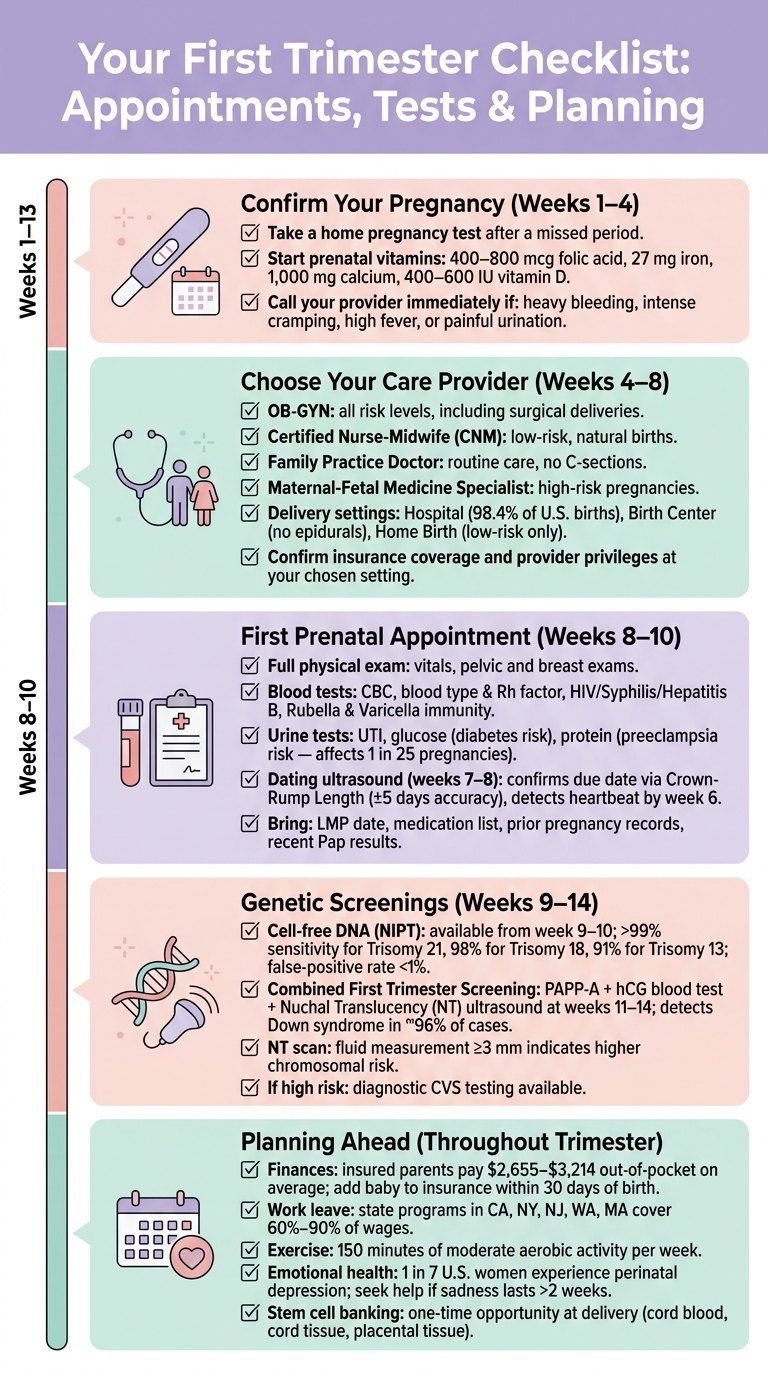
The first trimester (weeks 1–13) sets the stage for your baby's development, making early care and planning critical. Here's a quick breakdown of what to focus on during this period:
- Confirm Your Pregnancy: Take a home test after a missed period. Start prenatal vitamins right away.
- Choose a Provider: Decide between an OB-GYN, midwife, or family doctor based on your needs. Confirm insurance coverage and delivery location.
- Schedule Your First Appointment: Typically between 8–10 weeks, this visit includes a detailed health review, physical exams, and lab tests.
- Understand Key Tests: Expect blood work, a urine test, and an early ultrasound to confirm your due date and pregnancy progress.
- Plan Ahead: Review your finances, insurance, and work leave policies. Look into stem cell banking and build a support system for emotional health.
Confirming Pregnancy and Choosing Your Care Team
Early Pregnancy Signs and First Steps
Missing a period is a common sign of pregnancy, but other early symptoms include feeling unusually tired, tender breasts, frequent trips to the bathroom, and nausea. If you suspect you're pregnant, a home pregnancy test can give you quick confirmation. These tests are typically very reliable starting from the first day of a missed period.
Once you get a positive result, it's time to start taking prenatal vitamins with folic acid and reach out to your healthcare provider. Don’t wait for your first in-person appointment to ask questions - your initial phone call is the perfect time to confirm whether any medications you're currently taking, whether prescription or over-the-counter, are safe to continue.
If you experience heavy bleeding, intense cramping, a high fever, or painful urination, contact your provider immediately.
How to Choose a Prenatal Care Provider
In the U.S., you have several options for prenatal care providers. These include:
- OB-GYNs: Specialists who manage everything from routine pregnancies to surgical deliveries.
- Certified Nurse-Midwives (CNMs): Experts in low-risk, natural births who work in hospitals, birth centers, or even home settings.
- Family Practice Doctors: Provide care for both you and your family, though most do not perform C-sections.
- Maternal-Fetal Medicine Specialists: Handle high-risk pregnancies requiring advanced care.
Where you plan to give birth is just as important. About 98.4% of births in the U.S. happen in hospitals, which offer epidurals, NICUs, and access to emergency surgical care. Birth centers, on the other hand, provide a more relaxed, home-like environment for low-risk pregnancies but don’t offer epidurals. Home births are another option for low-risk pregnancies, but they require a solid emergency transfer plan in case complications arise. Keep in mind that a provider can only deliver at locations where they have privileges, so confirm their affiliation with your chosen setting.
| Setting | Best For | Key Limitation |
|---|---|---|
| Hospital | All risk levels | More clinical environment |
| Birth Center | Low-risk, natural birth | No epidurals; transfer needed for complications |
| Home Birth | Low-risk, maximum privacy | No immediate emergency care on-site |
When selecting a provider, ask about their approach to after-hours calls and whether their communication style aligns with your preferences.
"The more we know about your health and the families' medical histories on both sides, the better we can care for you and ensure healthy fetal development throughout your pregnancy." - Kellann Gaines-El Hunter, CNM
It’s also smart to check your insurance coverage early. Some plans don’t cover standalone birth centers or certain types of midwives, and out-of-pocket costs can vary widely depending on your chosen care setting. Building a strong relationship with your provider now will set the tone for a smoother pregnancy experience. Once you've made your choice, schedule your first prenatal appointment right away.
When and How to Schedule Prenatal Appointments
As soon as you confirm your pregnancy, book your first prenatal visit - even if the appointment itself is a few weeks away. Most providers schedule the first in-person visit between 8 and 10 weeks after your last menstrual period (LMP). This initial visit is often the most detailed, so come prepared with your LMP date, your personal medical history, and a list of any medications you're taking. It’s also helpful to gather the baby's father's family medical history.
After the first visit, prenatal appointments follow a consistent schedule. Through week 28, you’ll likely have monthly checkups. As your due date gets closer, these visits become more frequent. During the first trimester, expect to have one or two appointments in total.
First Trimester Appointments: What to Expect
Your First Prenatal Visit: What Happens
The first prenatal visit is the most thorough appointment you'll have during your pregnancy. It usually takes place between 8 and 10 weeks after the first day of your last menstrual period and provides a detailed health assessment.
During this visit, you'll undergo a full physical exam, including checks of your vital signs, as well as pelvic and breast exams. Blood and urine tests will also be performed. Your provider will calculate your estimated date of delivery (EDD) using the 40-week rule from your last menstrual period. If needed, an early ultrasound may confirm this date.
"Early prenatal care is important because it gives your provider an opportunity to review your health history and identify risk factors we need to be proactive about." - Rebeca Moretto, Certified Nurse-Midwife, UNC Health
To make the visit smoother, bring the following:
- The date of your last menstrual period (LMP)
- A list of medications, supplements, or herbs you're taking
- Records from prior pregnancies
- Results of recent Pap tests
- Operative reports if you've had a previous C-section
Wearing clothing that’s easy to change can also make the physical exam more comfortable. After this detailed visit, future appointments will focus on routine monitoring. These steps are part of your overall first trimester checklist.
Follow-Up Visits and Routine Checks
After the initial visit, follow-up appointments are shorter and more straightforward. For pregnancies without complications, you'll typically have checkups every four weeks until week 28. In the first trimester, this usually means one follow-up visit after your first appointment.
At these visits, your provider will:
- Monitor your weight and blood pressure
- Test your urine for glucose and protein levels
- Listen for your baby’s heartbeat with a handheld Doppler (usually audible between weeks 10 and 12)
"Prenatal visits are a chance to spot any issues as early as possible." - Kellann Gaines-El Hunter, Certified Nurse-Midwife, Cleveland Clinic
If you notice heavy bleeding, severe abdominal pain, persistent vomiting, a high fever, or sudden swelling in your face or hands, contact your provider immediately. These are important steps to remember as part of your first trimester care.
When to See Additional Specialists
Based on your medical history or screening results, your provider might refer you to a specialist. Here are some examples of when referrals might occur:
| Condition or Sign | Specialist | Purpose |
|---|---|---|
| Pre-existing diabetes or hypertension | Maternal-Fetal Medicine (MFM) | To manage high-risk pregnancies |
| Abnormal genetic screening results | MFM or Genetic Counselor | For diagnostic testing like CVS or amniocentesis |
| Positive depression screening | Mental Health Professional | For support and treatment |
| Routine pregnancy care | Dentist | To maintain oral health during pregnancy |
Women over 35, those expecting multiples, or those with a BMI of 40 or higher may also be referred to a Maternal-Fetal Medicine specialist for closer observation. If genetic screenings reveal unexpected findings, a genetic counselor can help you understand your options. Additionally, scheduling a dental cleaning early in pregnancy supports overall health throughout all three trimesters. Acting promptly on referrals helps ensure a smoother pregnancy journey. These steps are part of your first trimester checklist.
First Trimester Tests and Screenings
Understanding the tests and screenings during your first trimester is an essential part of staying on top of your pregnancy and parenting journey. These assessments help keep both you and your baby healthy by identifying potential issues early.
Routine Blood and Urine Tests
At your first prenatal visit, your healthcare provider will order a series of blood and urine tests. These tests give a clear picture of your overall health and flag any concerns that might need closer attention.
| Test | Purpose |
|---|---|
| Complete Blood Count (CBC) | Checks for anemia by measuring hemoglobin levels |
| Blood Type & Rh Factor | Identifies Rh incompatibility that could harm fetal red blood cells |
| HIV, Syphilis & Hepatitis B | Screens for infections that could be passed to the baby |
| Rubella & Varicella Immunity | Ensures protection against infections linked to birth defects |
| Urinalysis & Urine Culture | Detects UTIs, glucose (diabetes risk), and protein (preeclampsia risk) |
Preeclampsia, which affects 1 in 25 pregnancies in the U.S., is a leading cause of complications for both mothers and babies. That’s why testing for protein in your urine is prioritized early in your care. If you have certain risk factors - like a BMI of 30 or higher, a family history of diabetes, or other medical conditions - your provider might also recommend early screening for thyroid function or gestational diabetes.
Once these lab tests are completed, an ultrasound is typically the next step in confirming your pregnancy’s progress.
First Trimester Ultrasounds
After your initial lab work, your provider will arrange for an early ultrasound. A dating ultrasound, usually scheduled between 7 and 8 weeks, confirms important details about your pregnancy. If there’s abnormal bleeding or uncertainty about your last menstrual period, an earlier ultrasound (around 5 weeks) may be done to rule out issues like ectopic pregnancy.
The early ultrasound serves several purposes:
- Confirms an intrauterine pregnancy
- Estimates your due date using Crown-Rump Length (CRL), accurate within ±5 days
- Detects a fetal heartbeat, typically visible by week 6
- Identifies if you’re carrying multiples
"Cardiac activity is often present when the embryo measures 2 mm or greater during the 6th week of gestation." - StatPearls
Later in the first trimester, between 11 and 14 weeks, a specialized Nuchal Translucency (NT) scan is performed. This scan measures the fluid at the back of the baby’s neck, with a measurement of 3 mm or more indicating a higher risk for chromosomal abnormalities.
Genetic Screening Options
The American College of Obstetricians and Gynecologists (ACOG) advises offering genetic screening to all pregnant individuals, regardless of age or risk factors.
There are two main screening methods available during the first trimester:
- Cell-free DNA (cfDNA) screening, also known as NIPT, is a simple blood test available as early as 9–10 weeks. It analyzes fragments of placental DNA in the mother’s blood and is highly accurate, with over 99% sensitivity for Trisomy 21 (Down syndrome), 98% for Trisomy 18, and 91% for Trisomy 13. The false-positive rate is under 1%.
- Combined first trimester screening involves a blood test that measures PAPP-A and hCG levels, paired with the NT ultrasound. Together, these detect Down syndrome in about 96% of cases.
It’s important to remember that these screenings assess risk, not provide a definitive diagnosis. If results suggest a higher risk, diagnostic tests like chorionic villus sampling (CVS) can confirm the findings. Your provider or a genetic counselor can help you interpret the results and decide on next steps. These tests give you valuable information to help you plan for the journey ahead.
Planning Ahead: Health, Finances, and Emotional Wellbeing
With your prenatal appointments and screenings in place, it's time to step back and focus on the bigger picture - your daily habits, financial readiness, and emotional health. Tackling these areas early can make the rest of your pregnancy feel much more manageable. A little planning now can set you up for a smoother experience in the months ahead.
Building Healthy Habits During Pregnancy
One of the first steps? Start taking a prenatal vitamin right away.
"Ideally, you should start taking your prenatal vitamins the month before your pregnancy begins." - Kaiser Permanente
Look for a prenatal vitamin with 400–800 mcg of folate or folic acid (essential for preventing neural tube defects), 27 mg of iron, 1,000 mg of calcium, and 400–600 IU of vitamin D. Stick with tablets or capsules, as gummy vitamins often lack iron and don’t absorb as well.
When it comes to nutrition, focus on quality over quantity.
"You do not need to eat for two, but you do need to nourish your body well." - Nina Spears, Founder and CEO, Baby Chick
This means adding about 350–450 extra calories daily from nutrient-rich foods. Avoid high-mercury fish like shark, swordfish, and king mackerel, as well as raw seafood and unpasteurized dairy. Keep caffeine intake to a minimum.
Staying active is equally important. Aim for 150 minutes of moderate aerobic exercise each week - activities like walking, swimming, or prenatal yoga are great options. Avoid sports with a risk of falling or contact injuries. If nausea or fatigue is making things tough, try small, frequent meals and keep ginger or crackers handy. And don’t underestimate the importance of rest - aim for at least 8 hours of sleep each night.
Financial and Work Planning
The financial side of pregnancy can sneak up on you. In the U.S., insured parents typically pay between $2,655 and $3,214 out-of-pocket for pregnancy and delivery, even with good coverage. Start by contacting your insurance provider to confirm your out-of-pocket maximum and check if pre-authorization is needed for upcoming tests or specialist visits. Also, keep in mind that you usually have just 30 days after birth to add your baby to your health insurance plan.
On the work side, review your employer’s parental leave policy now. If you’re in states like California, New York, New Jersey, Washington, or Massachusetts, state-paid leave programs may cover 60%–90% of your wages. Consider opening a dedicated savings account for baby-related costs, as monthly expenses can add up quickly. Planning ahead with your insurer and employer can help avoid surprises.
Newborn Stem Cell Banking with Americord
While organizing your finances, consider options for your newborn’s future health. The first trimester is an ideal time to explore newborn stem cell banking, a one-time opportunity at delivery. Stem cells from cord blood, cord tissue, and placental tissue collected at birth may be used to treat certain blood disorders, immune conditions, and other diseases.
Americord Registry offers several plans tailored to your needs:
| Plan | What's Included |
|---|---|
| Essential Family | Cord Blood Banking |
| Advanced Family | Cord Blood + Cord Tissue Banking |
| Complete Family | Cord Blood + Cord Tissue + Placental Tissue Banking |
| Ultimate Family | All above + Newborn Exosome Banking |
| Maximum Family | All above + Maternal Exosome Banking |
Americord uses CryoMaxx™ processing technology, storing samples in 5-compartment vials for multiple uses. Their AABB accreditation ensures high-quality standards. If you decide to proceed, keep the collection kit at room temperature and inform your delivery team at least six weeks before your due date.
Emotional Wellbeing and Building a Support Network
Pregnancy often brings a rollercoaster of emotions, thanks to hormonal shifts. It’s common to experience mood swings, heightened emotions, or irritability - similar to PMS but more intense.
"Feeling weepy, anxious, or unusually emotional is entirely normal." - Alliance OB/GYN
However, if feelings of sadness, hopelessness, or being overwhelmed last for more than two weeks, it’s important to reach out to your provider. About 1 in 7 U.S. women face perinatal depression, and prenatal visits often include screenings like the Edinburgh Postnatal Depression Scale - be honest during these evaluations.
Building a support network can make a big difference. Lean on your partner, friends, or family to share your thoughts and concerns. Joining prenatal yoga classes or childbirth prep courses can connect you with other expecting parents. Writing in a pregnancy journal can also help you process your emotions during this transformative time.
"Take care of yourself and look to loved ones for understanding and support." - Mayo Clinic
Conclusion: Staying Organized for a Healthy Pregnancy
The first trimester is a whirlwind of tasks - confirming your pregnancy, selecting a healthcare provider, scheduling tests, and making lifestyle changes. Staying organized during this time is crucial for a smoother, less stressful journey.
After your first prenatal visit, update your calendar with all upcoming appointments and tests. Keep a running list of questions to discuss with your provider at each visit. They are your go-to resource for guidance, so don’t hesitate to lean on their expertise.
At the same time, stay on top of practical matters like insurance coverage, work leave options, and decisions such as is newborn stem cell banking worth it. These steps, combined with your focus on emotional and financial planning, set a solid foundation for the months ahead. By planning thoughtfully, staying connected with your support system, and staying proactive, you’ll feel more prepared for what’s to come.
FAQs
What should I do right after a positive pregnancy test?
After confirming your pregnancy with a positive test, the next step is to schedule your first prenatal appointment with an obstetric care provider. When booking, let them know about your positive result - they might offer guidance on taking prenatal vitamins or discuss the safety of any medications you’re currently using.
It’s also a good idea to check your health insurance to understand what’s covered for prenatal care and childbirth. At the same time, start thinking about maternity leave and budgeting for upcoming baby-related expenses. Staying on top of these details early can help you feel more organized and ready for what’s ahead.
How do I choose between an OB-GYN, midwife, or family doctor?
Choosing the right provider - whether an OB-GYN, midwife, or family doctor - depends on your health and how you envision your birth experience.
- OB-GYNs are a great choice if your pregnancy is high-risk, you anticipate complications, or you prefer a hospital setting for delivery.
- Midwives focus on low-risk pregnancies and often provide a more personalized approach, whether you’re planning a home birth, a birth center delivery, or even a hospital birth.
It’s also important to think about the facilities where each provider delivers and choose someone you feel comfortable with who supports your birth plan.
Which first-trimester tests are optional vs. recommended?
During the first trimester, your healthcare provider will run important blood and urine tests to screen for infections, determine your blood type, and assess your overall health. These tests play a key role in identifying potential issues early on. You may also have the option to undergo genetic screenings, such as non-invasive prenatal testing (NIPT) or nuchal translucency scans, which evaluate the likelihood of chromosomal conditions. Talk with your provider to decide on the tests that best suit your preferences and priorities.
The views, statements, and pricing expressed are deemed reliable as of the published date. Articles may not reflect current pricing, offerings, or recent innovations.


