

FACT vs. AABB: Lab Safety Standards Explained
FACT (Foundation for the Accreditation of Cellular Therapy) and AABB (Association for the Advancement of Blood & Biotherapies) are two organizations that set safety and quality standards for stem cell banking and cellular therapy. Both ensure that facilities meet rigorous protocols for handling, storing, and using stem cells, but their focus and scope differ:
- FACT emphasizes clinical integration, focusing on the entire process from donor collection to patient administration, including hematopoietic and immune effector cells like CAR-T.
- AABB applies a broader approach, covering blood and biotherapies, and aligns with U.S. regulations like CMS and HRSA requirements.
Key Points:
- FACT requires a quality management system, staff competency, and full traceability.
- AABB mandates donor eligibility checks, infectious disease testing, and uses the ISBT 128 labeling system.
- FACT collaborates globally (e.g., JACIE in Europe), while AABB has a U.S.-centric regulatory focus with international reach.
Quick Comparison:
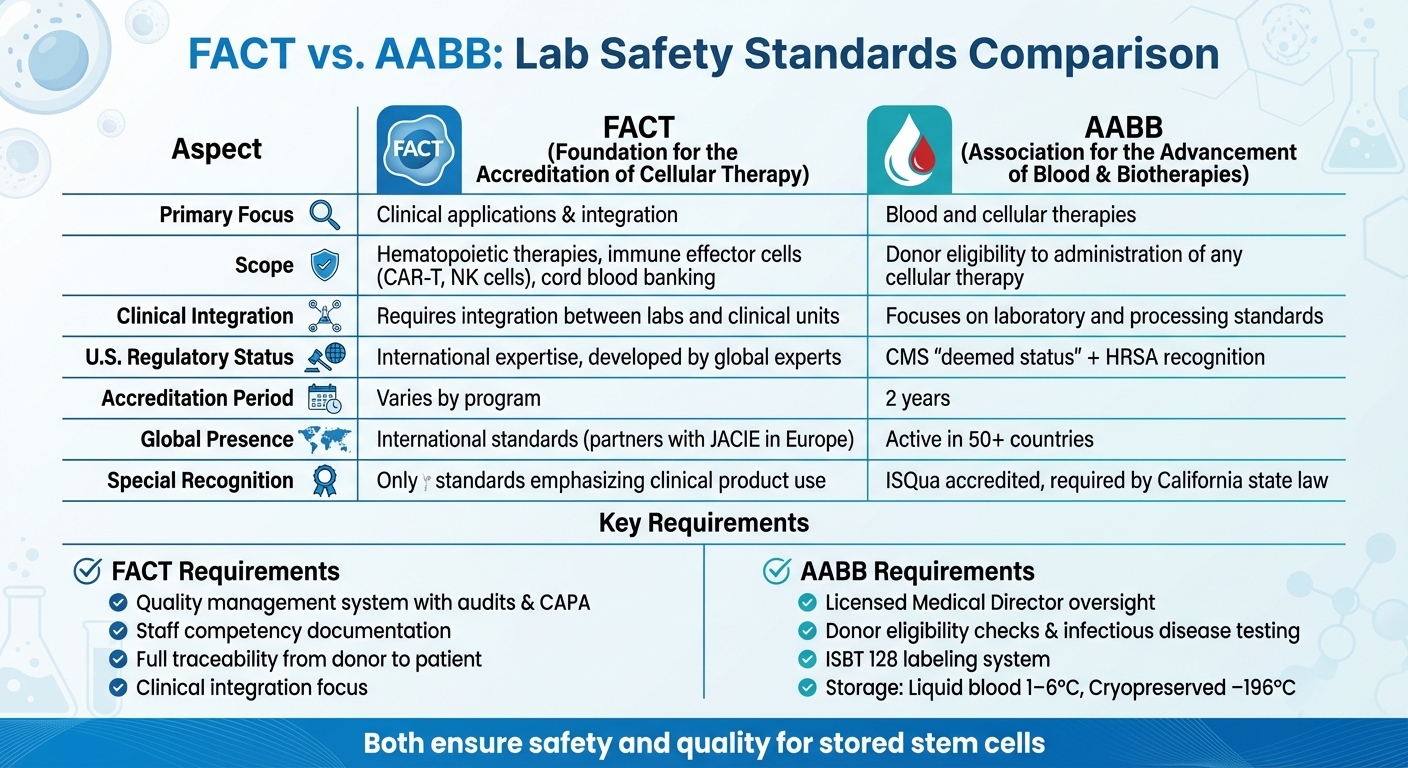
| Aspect | FACT | AABB |
|---|---|---|
| Focus | Clinical applications | Blood and cellular therapies |
| U.S. Regulations | International expertise | CMS "deemed status", HRSA aligned |
| Accreditation Period | Varies | 2 years |
| Global Presence | International standards | Active in 50+ countries |
Both accreditations ensure safety and quality for stored stem cells, offering families confidence in their long-term medical use. This is especially important when choosing between public vs private cord blood banking options. Facilities choose based on regulatory needs, operational goals, and global reach.
FACT Standards for Cellular Therapy
Main Requirements for FACT Accreditation
FACT takes a holistic approach, addressing both clinical and laboratory processes. This spans everything from donor selection and collection to the processing, storage, and eventual administration of cells to patients.
"Quality care can only be achieved if both clinical and laboratory issues are effectively addressed." - FACT
Facilities aiming for FACT accreditation must implement a quality management system that includes regular audits, detailed meeting records, adverse reaction reports, and corrective and preventive actions (CAPA). These facilities also need to provide thorough documentation that aligns FACT standards with their internal SOPs and policies, ensuring that every requirement is seamlessly integrated into daily operations.
Staff qualifications are another critical area. Facilities must show that key personnel, such as Organization, Medical, and Facility Directors, as well as Quality Managers, meet documented competency standards. Additionally, the standards require full traceability, tracking every step from donor identification to the final administration of cells, ensuring accountability and transparency throughout the process.
FACT also tailors its standards to specific areas of cellular therapy. For cord blood banking, the requirements cover a wide range of activities, including donor management, collection, processing, testing, cryopreservation, storage, and distribution. Meanwhile, the "Common Standards" provide a foundation applicable to any cell source or therapeutic application, extending even to non-hematopoietic cells and clinical trials.
FACT's reach isn't confined to the U.S.; its rigorous standards align with international practices, helping to set the bar for cellular therapy worldwide.
FACT Standards Around the World
FACT's influence extends far beyond domestic borders. Through its partnership with JACIE (Joint Accreditation Committee ISCT-Europe & EBMT), the organization has helped establish unified international standards for hematopoietic cellular therapy. This collaboration ensures that facilities across Europe and other regions can meet globally recognized benchmarks for quality and safety.
The standards themselves are grounded in scientific evidence and crafted by international teams of experts, including clinicians, scientists, and quality specialists. They are based on published medical research and established scientific theories. The development process is thorough and transparent, involving public reviews, legal evaluations, and final approval by FACT's Board of Directors. This collaborative approach ensures the standards evolve alongside advancements in regenerative medicine, offering a framework that's both rigorous and adaptable to new innovations.
AABB Standards for Blood and Cellular Therapy
Main Requirements for AABB Accreditation
AABB takes a comprehensive approach to the entire cellular therapy lifecycle, backed by over six decades of expertise in setting standards.
Facilities seeking accreditation must appoint a licensed Medical Director who oversees both medical and technical policies. Additionally, they are required to document the qualifications of all staff members, covering their education, training, and experience.
Donor safety and eligibility are central to AABB standards. Facilities must provide donors with educational materials about transfusion-transmitted infections, ensure private donor screening, and conduct required infectious disease testing for conditions like HIV, HCV, HTLV, and T. cruzi. Storage requirements are also strictly defined: liquid blood must be kept at 1–6°C, while cryopreserved products are stored at –196°C using vapor-phase nitrogen.
For product labeling, AABB employs the ISBT 128 system, the global standard for labeling medical products derived from human origin. The most recent edition of the Standards for Cellular Therapy Services (12th edition) became effective on July 1, 2025. Facilities must also undergo on-site assessments every two years to maintain their accreditation. These rigorous standards are now implemented in over 50 countries, aligning closely with the protocols of FACT.
Such stringent measures highlight AABB's significant role in ensuring quality and safety within the field of cellular therapy.
AABB's Role in U.S. Regulations
Beyond its accreditation standards, AABB plays a key role in shaping regulatory compliance across the U.S.
AABB holds a "deemed status" from the Centers for Medicare and Medicaid Services (CMS), allowing its assessments to meet federal inspection requirements under the Clinical Laboratory Improvement Amendments (CLIA). This designation simplifies regulatory compliance for accredited facilities.
The organization also collaborates with the FDA to help facilities interpret and adhere to federal regulations, especially those outlined in 21 CFR 1271. In many cases, AABB standards not only align with but exceed the federal requirements detailed in the U.S. Code of Federal Regulations. For example, in California, state law mandates that all laboratories follow AABB standards, effectively making them a legal requirement.
Furthermore, the Health Resources and Services Administration (HRSA) requires AABB accreditation for cord blood banks participating in the National Cord Blood Inventory. This requirement helps parents determine if cord blood banking is worth it for their family's needs. Adding to its credibility, the AABB Accreditation Program is the only U.S. program accredited by the International Society for Quality in Healthcare (ISQua), reinforcing its authority and trustworthiness in the healthcare sector.
FACT vs. AABB: How They Compare
Differences in Scope and Focus
FACT and AABB each bring their own unique focus and scope to accreditation. FACT is heavily centered on clinical integration, emphasizing the entire process of cell manufacturing and administration. This includes hematopoietic cellular therapies (like marrow and peripheral blood), immune effector cells (such as CAR-T and NK cells), and cord blood banking. A key aspect of FACT’s approach is its requirement for integration between laboratories and clinical units that administer these therapies, ensuring a seamless connection between production and patient care.
On the other hand, AABB takes a broader approach, covering all stages of donor selection, collection, processing, storage, and administration for cellular therapy products. With decades of experience in setting standards, AABB’s framework extends beyond cellular therapies into the wider field of blood and biotherapies. AABB also holds "deemed status" from CMS for cellular therapy laboratories and is recognized by HRSA for the Bill Young Transplant Program. FACT, in contrast, develops its standards through international committees of experts, applying them globally.
For stem cell banking facilities, these differences highlight distinct operational priorities and compliance advantages, depending on which accreditation aligns better with their goals.
Shared Safety and Quality Requirements
While their scopes differ, FACT and AABB share a commitment to safety and quality. Both require strict donor eligibility standards to ensure cellular therapy products are sourced from properly screened donors. Rigorous quality systems, environmental monitoring, and testing protocols are also mandatory for both organizations to protect patient safety.
One notable difference is the operational timeline for accreditation. AABB requires facilities to operate for at least six months before applying for initial accreditation, whereas FACT’s timeline may vary depending on the specific program. These shared and differing elements provide a foundation for comparing the two organizations head-to-head.
Side-by-Side Comparison of FACT and AABB Standards
The table below highlights the key distinctions between FACT and AABB:
| Aspect | AABB Standards | FACT Standards |
|---|---|---|
| Primary Focus | Broad coverage of blood and biotherapies | Comprehensive cell processing and clinical application |
| Scope | From donor eligibility to administration of any cellular therapy | Hematopoietic therapies, immune effector cells, cord blood banking |
| Clinical Integration | Focuses on laboratory and processing standards | Prioritizes integration between labs and clinical units |
| U.S. Regulatory Status | CMS "deemed status" and HRSA recognition | Standards developed by international experts |
| Accreditation Period | Two years | Varies by program |
| Global Presence | Active in over 50 countries | Applied internationally |
| Special Recognition | ISQua accreditation; required by California state law | Only standards emphasizing clinical product use |
Understanding Accreditation for Stem Cell Banking Facilities
How Facilities Choose Between FACT and AABB
When it comes to accreditation, stem cell banking facilities weigh several practical and regulatory factors to make their decision. The choice often hinges on regulatory alignment, financial impact, and operational priorities.
Regulatory alignment plays a significant role. Facilities that need "deemed status" from CMS or must comply with HRSA contracts often opt for AABB accreditation. This is because AABB assessments can satisfy federal and state inspection requirements, simplifying the compliance process.
Financial aspects are another consideration. AABB accreditation can lower liability insurance costs and is recognized by major insurers like Aetna for reimbursement. For facilities with international operations, AABB's presence in over 50 countries and its ability to provide tailored joint accreditations make it a compelling choice. However, the accreditation process, which typically takes 1 to 2 years, requires careful planning. Additionally, state-specific regulations may influence the decision.
The focus of the accreditation also matters. FACT standards, crafted by international experts, emphasize clinical applications of cellular therapy products. On the other hand, AABB accreditation offers broader regulatory and global advantages.
Ultimately, these accreditation decisions influence how families perceive the quality and reliability of stem cell banking facilities.
What Accreditation Means for Families
For families banking their newborn's cord blood, tissue, and placenta, accreditation provides peace of mind by ensuring safety and quality at every stage - from donor selection to clinical use. Both FACT and AABB accreditations hold facilities to strict standards designed to preserve the viability of stored stem cells for future medical treatments.
However, families should look beyond accreditation alone when evaluating facilities. For example, it's crucial to confirm that the facility uses FDA-approved anticoagulants like Citrate Phosphate Dextrose instead of Heparin, which is not FDA-approved for cord blood collections.
Quality guarantees further reinforce a facility's commitment to safety. Americord Registry, for instance, offers a $110,000 engraftment guarantee, showcasing its dedication to maintaining high standards. With 1 in 3 people potentially benefiting from regenerative medicine or stem cell transplants in their lifetime, choosing an accredited facility ensures that families are investing in a service that meets stringent safety and quality criteria.
Conclusion: Safety and Quality in Stem Cell Banking
FACT and AABB standards share a common goal: ensuring robust safety measures throughout the stem cell banking process. Both accreditations require that stored stem cells meet stringent clinical quality requirements.
While both focus on safety, the accreditation processes highlight different strengths. AABB prioritizes a broad quality systems approach, whereas FACT places more emphasis on clinical applications. Both organizations rely on top experts to continually refine their standards based on the latest medical advancements.
For families exploring stem cell banking, accreditation serves as a clear indicator of a facility's commitment to high-quality practices. Proper storage and handling are critical, and accredited facilities demonstrate the ability to safeguard these precious biological materials for potential medical use in the future.
These quality standards provide families with peace of mind, knowing their investment is secure. When comparing stem cell banking options, it's essential to choose facilities with current accreditation and transparent quality protocols. Additional safeguards, such as FDA-approved collection methods and financial protections, further ensure long-term security.
At Americord Registry, we adhere to these high standards, protecting your stem cell banking investment to support potential health benefits in the future. Accredited facilities represent the intersection of safety and quality, providing families with confidence in their decision.
FAQs
Which accreditation matters more for my family, FACT or AABB?
Both FACT and AABB accreditations play a key role in ensuring safe and high-quality cord blood banking. While AABB emphasizes quality management systems and technical standards, FACT focuses more on clinical outcomes and research, often with stricter protocols. If you value rigorous clinical standards, FACT might align better with your priorities. However, both certifications reflect a strong dedication to safety and dependability.
Does accreditation guarantee my baby’s stem cells will be usable later?
Accreditation plays a key role in making sure stem cells are collected, processed, and stored under rigorous standards. But it's important to understand that accreditation alone doesn't promise these stem cells will be usable in the future. Other factors, like how well they were collected, the conditions under which they were stored, and their medical compatibility, also significantly impact their potential for use.
What other quality signs should I check besides FACT or AABB?
When evaluating stem cell banks, consider accreditations beyond FACT and AABB. Look for certifications such as JACIE, and ensure compliance with standards set by organizations like the FDA, CLIA, and CAP. Additionally, prioritize banks that are transparent about their processing and storage methods. Facilities with multiple accreditations and well-documented safety protocols often provide a higher level of quality and reliability for stem cell preservation.
The views, statements, and pricing expressed are deemed reliable as of the published date. Articles may not reflect current pricing, offerings, or recent innovations.

